
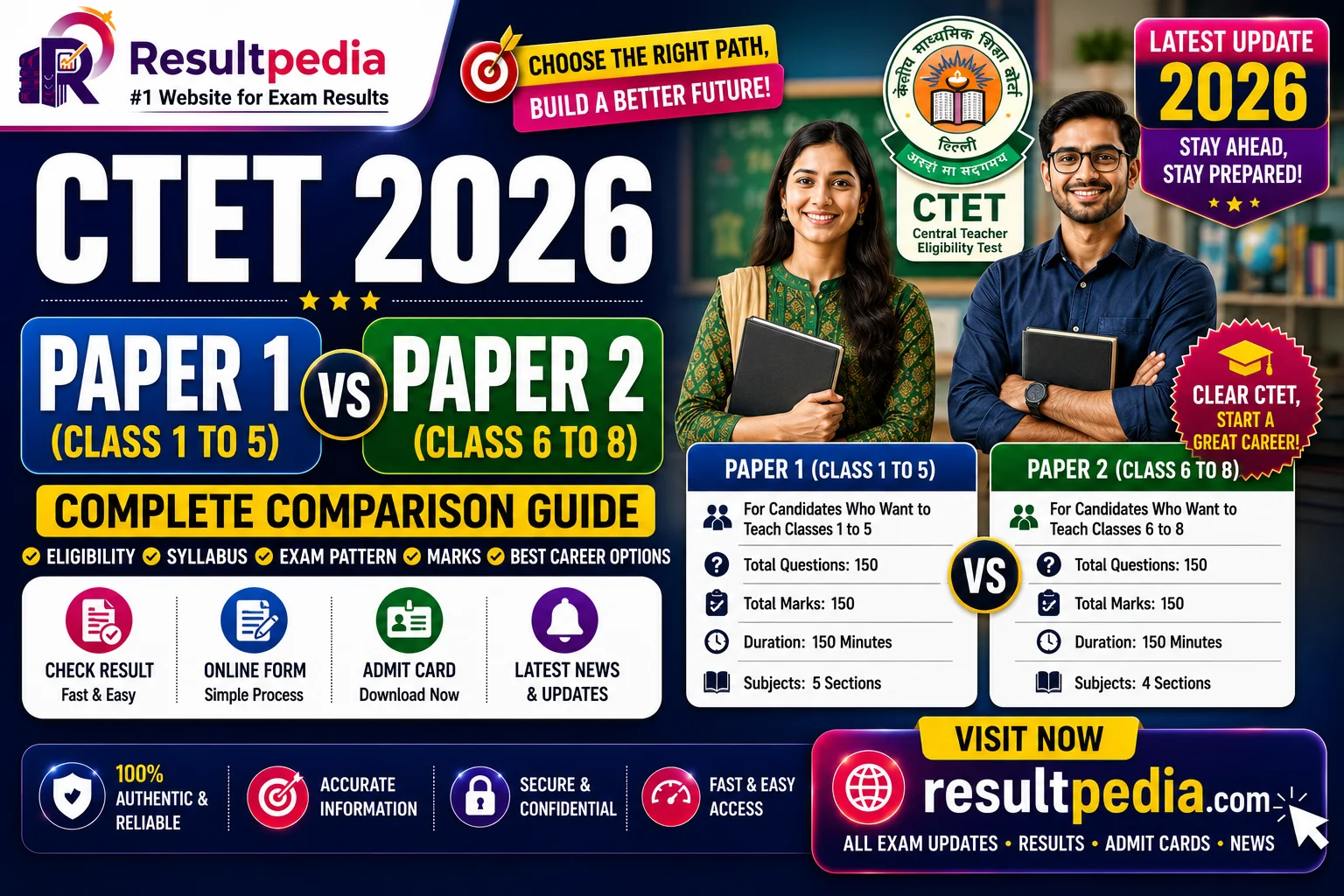
CTET has two papers: Paper 1 qualifies you to teach classes 1–5 and Paper 2 for classes 6–8. Both are 150 MCQs in 2.5 hours with no negative marking and a 60% qualifying bar. This guide explains the difference, eligibility, pattern, a section-wise strategy, and whether to take one paper or both.
By Saurabh Kamal, State PSC & Education Editor. Published 22 May 2026. Last verified 22 May 2026 against the CBSE CTET exam pattern; confirm the September 2026 schedule in the official notice.
TL;DR
- CTET has two papers. Paper 1 qualifies you to teach classes 1–5; Paper 2 qualifies you for classes 6–8. You can take one or both, depending on the level you want to teach.
- Both papers are 150 MCQs in 2.5 hours, no negative marking, and you need 60% (90/150) to qualify (relaxed for reserved categories).
- Child Development & Pedagogy (CDP) is common to both papers and is the highest-return section — master it once and it helps in both.
- Paper 2 splits by stream: Mathematics & Science OR Social Studies/Social Science — pick the one matching your graduation subjects.
- The CTET certificate is now valid for life, so clearing it once is a permanent eligibility asset.
If you are preparing for CTET September 2026, the first decision is not how to study but which paper to take. CTET (the Central Teacher Eligibility Test, conducted by CBSE) has two papers for two different teaching levels, and choosing the right one — or both — shapes your whole preparation. This guide explains the difference, the eligibility, the pattern, and a section-wise strategy. For the application details, see the CTET September 2026 page and the Teaching Jobs hub.
Paper 1 vs Paper 2 — what each qualifies you for
| Paper 1 | Paper 2 | |
|---|---|---|
| Teaching level | Classes 1–5 (primary) | Classes 6–8 (upper primary) |
| Who should take it | Aspiring primary teachers | Aspiring upper-primary/subject teachers |
| Eligibility | 12th (50%) + D.El.Ed (or equivalent) | Graduation + B.Ed / D.El.Ed |
| Format | 150 MCQs, 150 marks, 2.5 hrs, no negative marking | Same |
| Sections | CDP, Language I, Language II, Maths, EVS (30 each) | CDP, Language I, Language II (30 each) + Maths & Science or Social Studies (60) |
Take both papers if you are eligible and want to teach across the 1–8 range — you sit them in separate shifts on the same day. Otherwise, pick the paper matching the level you intend to teach.
Eligibility — check before you pick
Paper 1 needs a senior secondary (12th) pass with about 50% plus a Diploma in Elementary Education (D.El.Ed) — completed or in the final year. Paper 2 needs a graduation degree plus a B.Ed (or D.El.Ed in some cases). If you hold both a degree and a teaching qualification, you can attempt both papers and widen the classes you are eligible to teach. Confirm the exact percentage and qualification combinations in the official CBSE notice, since reserved categories get relaxations.
Exam pattern and qualifying marks
Both papers are 150 multiple-choice questions for 150 marks in 2.5 hours, with no negative marking — so attempt every question. The qualifying bar is 60%, i.e. 90 of 150, with relaxation (typically to 55%) for SC/ST/OBC/PwD candidates per the notice. Because there is no negative marking, accuracy strategy is different from exams like SSC or banking: never leave a blank. The Child Development & Pedagogy section carries 30 marks in both papers and is the most scoring with focused preparation, so it deserves the first and the most attention.
Section-wise strategy
Child Development & Pedagogy (CDP) is the backbone — learning theories (Piaget, Vygotsky, Kohlberg), inclusive education, and assessment. It is common to both papers, so a single strong CDP base pays off twice. Language I and Language II test your teaching language and a second language through comprehension and pedagogy — pick languages you are genuinely comfortable with. For Paper 1, Mathematics and Environmental Studies are at upper-primary conceptual depth but framed pedagogically. For Paper 2, choose the Mathematics & Science or Social Studies block based on your graduation subjects — do not switch to an unfamiliar stream for a perceived easier scoring. Across both papers, roughly half the weight is pedagogy rather than raw content, so candidates who study how to teach a topic, not just the topic, score higher.
Should you take one paper or both?
If your goal is primary teaching (classes 1–5), Paper 1 alone is enough. If you want upper-primary subject teaching (6–8), take Paper 2. If you are eligible for both and want maximum flexibility in job applications — especially for KVS, NVS, and state teacher recruitments that ask for CTET — sitting both papers is worth it, since the certificate is now valid for life. The shared CDP and Language sections mean the extra preparation for the second paper is smaller than it looks. For where teaching roles sit among graduate options, see government jobs for graduates; for 12th-eligible routes, see 12th-pass jobs.
CTET 2026 Paper 1 vs Paper 2: हिंदी सारांश
CTET में दो पेपर होते हैं — Paper 1 कक्षा 1–5 (प्राथमिक) के लिए और Paper 2 कक्षा 6–8 (उच्च प्राथमिक) के लिए। दोनों में 150 MCQ, 150 अंक, 2.5 घंटे, कोई नेगेटिव मार्किंग नहीं, और क्वालिफाई करने के लिए 60% (90/150) चाहिए (आरक्षित वर्ग को छूट)। Child Development & Pedagogy (CDP) दोनों पेपरों में समान है और सबसे ज़्यादा स्कोरिंग सेक्शन है। Paper 1 के लिए 12वीं + D.El.Ed, Paper 2 के लिए ग्रेजुएशन + B.Ed चाहिए। CTET सर्टिफिकेट अब आजीवन मान्य है। यदि आप दोनों स्तरों पर पढ़ाना चाहते हैं और पात्र हैं, तो दोनों पेपर दें। आवेदन जानकारी के लिए CTET September 2026 पेज देखें।