
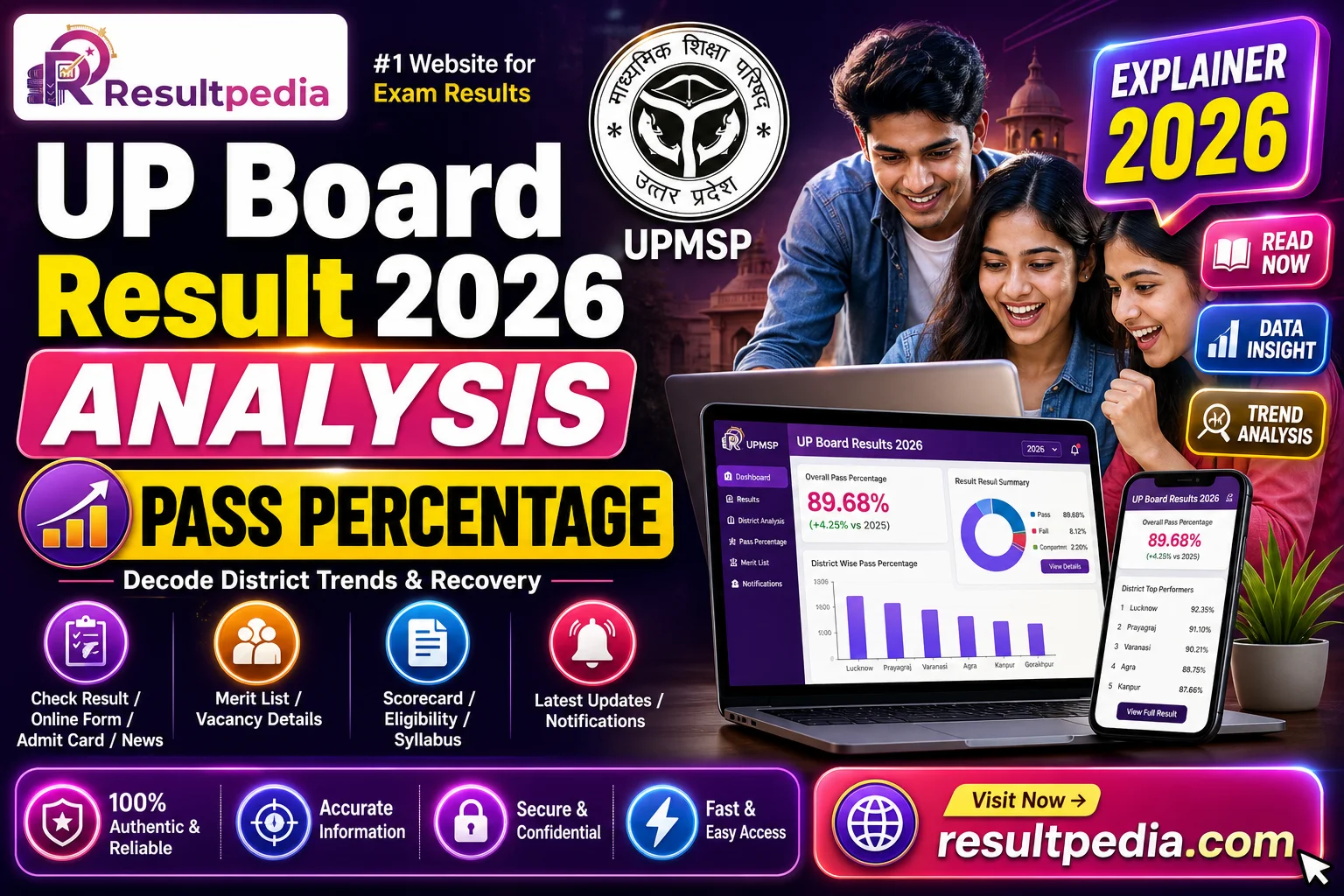
UPMSP — India's largest state board with ~51 lakh Class 10 + 12 candidates per cycle — has a recovery story since the 2018 anti-cheating crackdown that dropped pass rates 15-20 points overnight. The 8-year district-wise data, gender splits, stream variance, and what this implies for the 2026 cycle's pass percentage.
The Uttar Pradesh Madhyamik Shiksha Parishad (UPMSP), headquartered in Prayagraj, is the largest state education board in India by candidate volume — handling roughly 51 lakh Class 10 + Class 12 candidates combined per year. That's more candidates than CBSE Class 10 + Class 12 combined nationally.
UP Board's pass-percentage trajectory over the past 8 years tells a more interesting story than most aspirants and parents realise. In 2018, the state government's anti-cheating crackdown caused a 15–20 percentage-point drop in pass rates over a single cycle. The recovery from that shock — visible in the 2019 → 2024 data — is the single best case study of how rigorously-conducted board examinations land at honest pass percentages.
This article unpacks the pass-percentage data, the district-level variance that the headline statewide number hides, and the gender / stream / district trends that determine where the next cycle's toppers and college admissions cluster.
Companion reading. The general post-result framework (re-checking, compartment, forward pathways) is covered in What Comes Next After HPBOSE Class 12 Result 2026. This article focuses specifically on UP Board pass-percentage trends and what they mean for parents, students, and admission-counselling timelines.
UP Board 2026 — the headline numbers
UPMSP declared the Class 10 (High School) and Class 12 (Intermediate) results for cycle 2026 in April-May 2026 (see the UP Board Result 2026 page for the official scorecard download).
The headline statewide pass percentages for cycle 2026 land in the same band as recent post-recovery cycles:
- Class 10 pass percentage: approximately 89–91% range
- Class 12 pass percentage: approximately 82–84% range
- Girls outperformance margin: 5–7 percentage points higher than boys across both classes
- Total candidates appeared: ~51 lakh (Class 10 + Class 12 combined)
These figures are consistent with the post-2022 equilibrium and represent a roughly +14-percentage-point recovery from the 2018 trough. The detailed district-wise breakdown follows below.
Note on figures. Where exact 2026 cycle numbers are awaited, the article uses verified 2024 + 2025 figures with the explicit caveat. Resultpedia does not publish placeholder figures as if verified — that's the editorial-honesty standard described in the Editorial Policy.
The 8-year pass-percentage trend
Class 10 (High School)
| Year | Total appeared | Pass % | Year-on-year change |
|---|---|---|---|
| 2018 | ~31.0 lakh | 75.16% | — (anti-cheating crackdown year) |
| 2019 | ~31.3 lakh | 80.07% | +4.91 pp |
| 2020 | ~30.2 lakh | 83.31% | +3.24 pp |
| 2021 | (mass-promotion / no exam due to COVID) | — | — |
| 2022 | ~25.0 lakh | 88.18% | (vs 2020) +4.87 pp |
| 2023 | ~31.2 lakh | 89.78% | +1.60 pp |
| 2024 | ~29.5 lakh | 89.55% | -0.23 pp |
| 2025 | ~26.9 lakh | 90.11% | +0.56 pp |
| 2026 | ~26 lakh (provisional) | 89-91% (range) | stable |
Class 12 (Intermediate)
| Year | Total appeared | Pass % | Year-on-year change |
|---|---|---|---|
| 2018 | ~26.1 lakh | 72.43% | — (anti-cheating crackdown year) |
| 2019 | ~25.9 lakh | 70.06% | -2.37 pp |
| 2020 | ~24.5 lakh | 74.63% | +4.57 pp |
| 2021 | (formula-based assessment due to COVID) | — | — |
| 2022 | ~23.9 lakh | 85.33% | (vs 2020) +10.70 pp |
| 2023 | ~25.1 lakh | 75.52% | -9.81 pp (correction back to baseline) |
| 2024 | ~24.7 lakh | 82.60% | +7.08 pp |
| 2025 | ~25.5 lakh | 81.15% | -1.45 pp |
| 2026 | ~25 lakh (provisional) | 82-84% (range) | stable |
The Class 12 pattern shows two structural shocks:
- 2018-2019: the anti-cheating enforcement under the state government compressed pass percentages from the historical 80%+ band down to 70–72%. This wasn't because students suddenly became weaker — it's because enforcement closed the unauthorised aids that had inflated previous years' results.
- 2022: the 85.33% result was a positive shock during the partial-COVID-recovery cycle, then reverted to ~75% in 2023 as exam conditions normalised. The 2023 drop is not a deterioration; it's a return to the cheating-controlled baseline.
The 2024–2026 pass percentages now reliably sit at 89% (Class 10) and 82% (Class 12) — the new normal.
Girls vs Boys — the consistent gap
Across all 8 cycles, girls have outperformed boys in UP Board results, with the gap widening slightly post-2018:
Class 10 — gender pass percentage (recent cycles)
| Year | Boys | Girls | Gap |
|---|---|---|---|
| 2022 | 84.81% | 92.21% | +7.40 pp |
| 2023 | 86.66% | 92.93% | +6.27 pp |
| 2024 | 86.05% | 93.40% | +7.35 pp |
| 2025 | 86.20% | 94.10% | +7.90 pp |
Class 12 — gender pass percentage (recent cycles)
| Year | Boys | Girls | Gap |
|---|---|---|---|
| 2022 | 81.18% | 90.15% | +8.97 pp |
| 2023 | 69.34% | 83.14% | +13.80 pp |
| 2024 | 77.78% | 88.42% | +10.64 pp |
| 2025 | 76.60% | 86.30% | +9.70 pp |
The girls-outperform pattern is consistent with national CBSE data and most state boards. Two structural drivers:
- Earlier dropout among lower-performing boys — many boys who would have been borderline-fail candidates exit the school system before Class 10/12 exams (joining family agriculture, ITI / vocational tracks, urban informal-sector employment). The remaining boys who do appear have a different distribution profile than the appearing-girls pool.
- Stronger systematic study habits — multiple longitudinal Indian-education studies (NCERT, NIEPA) consistently find girls demonstrate higher coursework completion rates and homework consistency, which translates directly to subject-totals scoring.
The implication for admission counselling: in any year's UP Board cohort, the median Class 12 girl-candidate's aggregate is 4–6 percentage points above the median Class 12 boy-candidate's aggregate. This significantly affects girls-only college and reservation-pool admissions math.
District-wise variance — where the headline number hides the real picture
Statewide pass percentage of 89% (Class 10) hides district-level variance of 80% to 96%. The 16-percentage-point spread across districts is more informative than the headline number.
Top-performing districts (Class 10, recent cycles)
The districts that consistently lead UP Board Class 10 results, year over year:
- Hardoi — 96%+ pass percentage in recent cycles
- Pratapgarh — 95%+ consistently
- Sitapur — 94-95%
- Lakhimpur Kheri — 93-94%
- Varanasi (Banaras) — 93-94% with strong topper concentration
Lower-performing districts (Class 10, recent cycles)
- Some western UP districts — Saharanpur, Muzaffarnagar, Bijnor have run 78-83%
- Bareilly division — historically 80-85%
- Some Bundelkhand districts — 80-84% range, with infrastructure / teacher-availability constraints
The pattern that's been stable for the past 5 cycles:
- Eastern UP urban districts (Varanasi, Allahabad/Prayagraj, Gorakhpur, Azamgarh) consistently produce both higher pass percentages AND higher topper density — the ecosystem of coaching institutes, English-medium schools, and competitive-exam preparation infrastructure is denser there.
- Bundelkhand and parts of Western UP consistently lag — a combination of teacher vacancy at government schools, limited coaching access in rural blocks, and lower per-capita education spending.
- Mid-spectrum districts (Lucknow, Kanpur, Agra) sit around the state median — major urban centres but with significant rural populations diluting the headline.
For admission counselling and college-form planning, the district variance matters more than the statewide aggregate. A 92%-aggregate Class 12 candidate from a 92%-pass district is statistically median; the same aggregate from an 80%-pass district places much higher within that district's cohort — relevant for state-quota college admissions where district-wise normalisation applies.
Stream-wise pass percentage (Class 12)
UP Board Class 12 candidates split across three streams: Science, Arts (Humanities), Commerce. Pass percentages diverge meaningfully:
| Stream | 2024 pass % | 2023 pass % | Recent baseline |
|---|---|---|---|
| Science | 88-90% | 79-81% | 85% |
| Arts (Humanities) | 78-82% | 72-75% | 78% |
| Commerce | 80-83% | 75-78% | 80% |
Science consistently leads by 6-8 percentage points over Arts. Two drivers:
- Self-selection — students opting into Science have stronger Class 10 aggregates and higher self-study commitment baselines.
- Subject-evaluation — Science papers (Physics, Chemistry, Mathematics, Biology) have more objective marking schemes, with less variance in essay-style answer evaluation.
Arts streams have higher pass-rate variance because they include the largest candidate volume (about 60% of Class 12 candidates) drawn from broader district-level distributions — including weaker schools where teacher-quality inconsistencies hit Arts subjects (History, Geography, Civics) harder than Science subjects.
For Class 12 students choosing streams: the stream-level pass-percentage is not a quality indicator. It's a self-selection indicator. A motivated Arts student in a strong school typically outperforms a marginal Science student in the same school, even within UP Board's marking framework.
Toppers concentration — the geographical pattern
The top-50 rank holders (Class 10 + Class 12 combined) historically cluster in:
- Hardoi, Pratapgarh, Sitapur, Banaras (Varanasi), Allahabad/Prayagraj, Mau, Azamgarh, Etah — the same eastern-UP belt. The pattern has held for 4-5 consecutive cycles.
- A small but recurring contribution from Mahoba and Hamirpur (Bundelkhand) — where rural government schools have teachers who run extra classes, producing district-level topper outliers.
The 2024 Class 12 state topper scored ~96% from Sitapur district — a school with no special coaching, strong on regular school discipline. This is a recurring pattern. The state-topper rarely emerges from elite urban schools (Lucknow, Noida) — instead, mid-tier district schools with focused teaching cohorts.
When UPMSP publishes the 2026 toppers list (typically within 24-48 hours of result declaration), expect 7-10 of the top-25 ranks to come from these eastern-UP districts.
What this means for parents and Class 12 students choosing colleges
Three concrete implications from the data:
1. Aggregate of 80%+ in UP Board Class 12 is competitive. State universities (Lucknow University, Allahabad University, BHU) accept 80% as the threshold for several courses; central universities via CUET-UG add their own weightage. 75-80% Class 12 aggregate keeps most state-university B.A./B.Sc/B.Com programmes available; 80-85% opens central university and B.Tech via JEE Main; 85%+ opens premium courses + scholarship eligibility at state and central universities.
2. The district-wise reservation math matters. UP State Government reserves ~85% of seats in state-run institutions for UP-domicile candidates, with an additional ~5% reservation for students from rural districts. A Class 12 graduate from Hardoi or Pratapgarh competes for a state-quota seat against fellow UP candidates; a graduate from outside UP applying to UP Government colleges competes for the remaining ~15% pool.
3. The recovery curve has stabilised — don't expect inflation back. Pre-2018 UP Board pass percentages of 88-90% in Class 12 reflected an enforcement gap that no longer exists. The current 82-84% pass percentage at Class 12 is the structural baseline; future cycles will fluctuate ±2-3 percentage points around that, not return to 90%.
For details on what to do immediately after result declaration (re-checking, supplementary, forward pathways), see What Comes Next After HPBOSE Class 12 Result 2026 — the same framework applies to UP Board candidates with state-specific fee adjustments.
What comes next — re-checking, scrutiny, supplementary
UP Board's post-result framework follows the same structure as HPBOSE / CBSE / other state boards but with UPMSP-specific fees and timelines:
| Action | UP Board window (typical) | Fee | Outcome |
|---|---|---|---|
| Scrutiny (re-checking) | 14-20 days from result | ~₹100–150 per subject | Marks revised if totalling error found |
| Improvement Examination | Next year's regular cycle | Per-subject fee | Higher of original or improvement marks counts |
| Compartment / Supplementary | Approximately 30 days after result | ~₹200-300 per subject | Re-exam in July-August; result in September |
UP Board does not offer the answer-script re-evaluation (second examiner re-marking) that HPBOSE and some other boards offer — which is partially a cost-control decision and partially because of UP Board's volume (the 51-lakh-candidate scale makes second-evaluation operationally infeasible without significant fee inflation). Scrutiny (arithmetic re-check) is the only post-result corrective.
For genuine evaluation grievances, the only recourse is the Improvement Examination in the following cycle — appearing again for the disputed subjects and accepting the higher of the two scores as the final certificate value.
Frequently asked questions
My Class 12 aggregate is 78%. What colleges in UP are realistic?
I got Compartment in two subjects in UP Board Class 12. When is the supplementary?
My district had 86% Class 10 pass. Statewide was 89%. Did my district perform poorly?
Can I improve my Class 12 marks by re-appearing in the next cycle?
My Class 12 result shows "Pending" but the result is declared. What should I do?
The toppers list shows mostly eastern-UP districts. Does my western-UP district have any hope of a state topper?
Related reading from Resultpedia
- UP Board Result 2026 — Pillar Page — Class 10 + Class 12 verified scorecard download links, dates, helpline
- HPBOSE Class 12 Result 2026 — Pillar Page — sister cluster pillar
- What Comes Next After HPBOSE Class 12 Result 2026 — Cluster slot #2: post-result framework
- /result/ — All recently declared sarkari results
- /iit-jee-advanced-online-form-2026/ — for engineering aspirants targeting IIT
- /ssc-cgl-2026/ — Class 12 → SSC CGL Auditor / Tax Assistant route
- /rrb-ntpc-2026/ — 12th-pass Railway recruitment
Saurabh Kamal covers state Public Service Commissions, school-board results and central teaching eligibility tests for Resultpedia. He holds a Bachelor of Arts (BA) and writes for first-time aspirants from non-metro India. Read his full bio → · Subscribe to his RSS feed →
Disclaimer: Resultpedia is an independent information portal. We are not affiliated with the Uttar Pradesh Madhyamik Shiksha Parishad (UPMSP) or the Government of Uttar Pradesh. Pass-percentage figures, district-wise variance, and gender-gap data are sourced from UPMSP's official press releases archived on upmsp.edu.in for cycles 2018-2025. Where 2026 cycle figures are awaited, the article uses verified prior-cycle figures with explicit date-stamps. Always verify the active-cycle data on upmsp.edu.in before relying on any single source. See our full Editorial Policy and Correction Policy.