
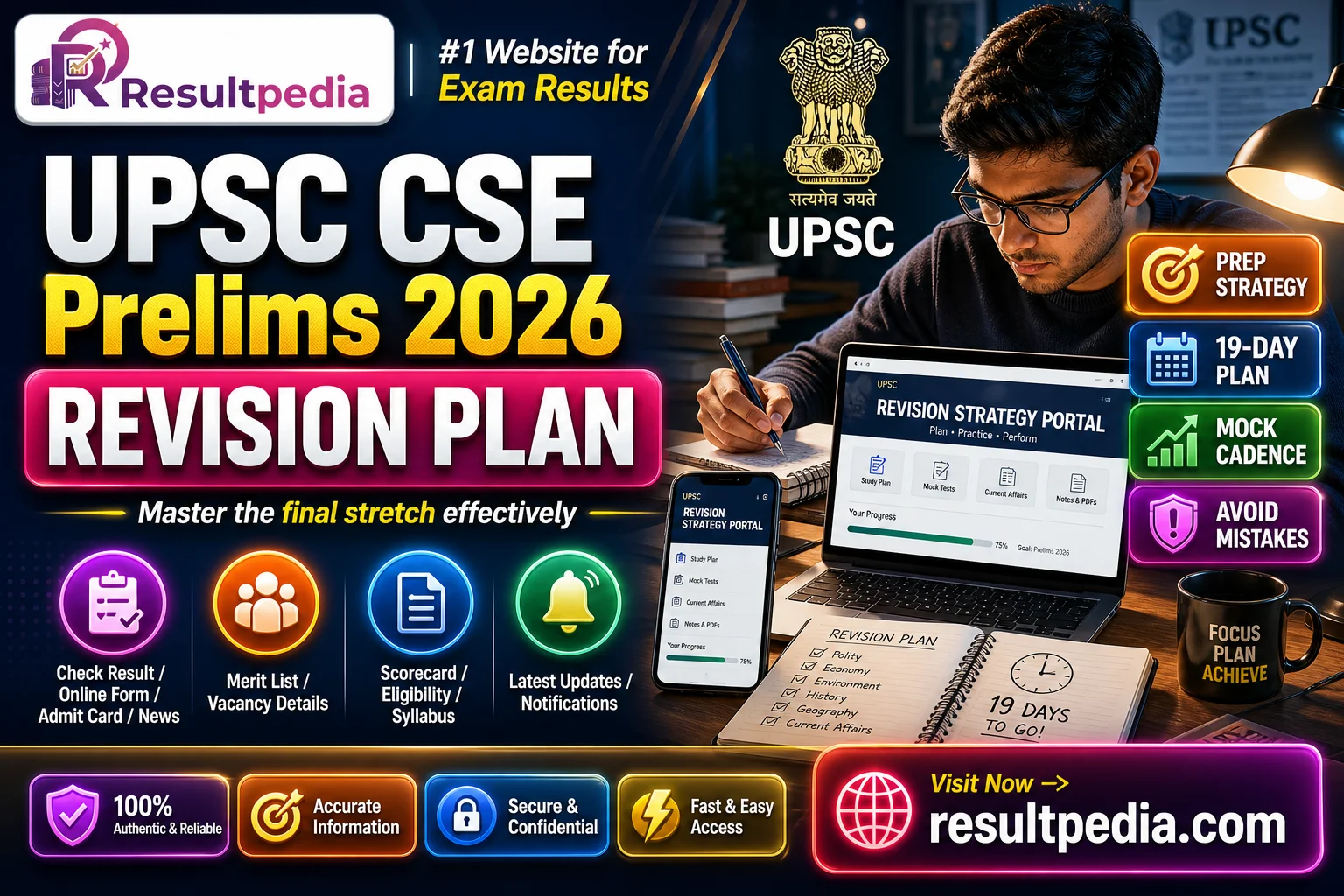
19 days to UPSC CSE Prelims (24 May 2026). The 5-1-1 weekly framework, GS-I topic-priority breakdown from 10-year analysis, the 90-minute mock-analysis ritual, and the five mistakes that cluster in the final fortnight.
If you are reading this on 5 May 2026, you have 19 days until UPSC Civil Services Preliminary Examination 2026 on Sunday, 24 May 2026. Two papers, same day: GS Paper-I (09:30–11:30 IST, merit-deciding) and CSAT Paper-II (14:30–16:30 IST, qualifying at 33%).
This article is not a syllabus list. You already have one. This is what to actually do in these 19 days — what previous-cycle candidates who cleared the GS-I cut-off (87.34 for UR in 2024) consistently say worked, what they avoided, and the exact weekly rhythm to keep.
If you only have time to read one section, jump to The 5-1-1 weekly framework — that's the part most aspirants get wrong in the final stretch.
What this guide assumes. You've completed at least one full reading of the GS-I syllabus, attempted 5+ full-length mocks, and have a working notebook of recurring errors. If you're starting cold today, the honest advice is to give 2026 a go for exposure but plan seriously for 2027.
The 5-1-1 weekly framework
Three weeks left, two and a half full weeks of useful preparation (the last 3 days are reserved for rest + exam-eve routine). The structure that holds together for high scorers is 5 days revision · 1 day full-length mock · 1 day analysis + targeted re-revision.
| Week | Dates | Focus | Mock day | Analysis day |
|---|---|---|---|---|
| W-3 (current) | 5–11 May | Polity + Modern History full revision | Sat 10 May | Sun 11 May |
| W-2 | 12–18 May | Geography + Economy + Environment | Sat 17 May | Sun 18 May |
| W-1 | 19–24 May | Current Affairs + Sci-Tech + targeted weak areas | Wed 21 May | Thu 22 May |
Five revision days are not "read everything top to bottom". They are: (a) read your own notes (not the textbook), (b) revise the topics where your previous mock attempts errored, (c) drill 50 PYQs from that subject area daily.
Mock day is full-length under exam conditions — same shift timing (09:30–11:30 IST), same OMR sheet, same room conditions. No phone for the 2 hours.
Analysis day is the highest-leverage day of the week. We'll come back to it under Mock-test cadence.
Topic priority for GS Paper-I
Based on 10-year frequency analysis of UPSC Prelims GS-I (2015–2024), the realistic weight of topics in the final 19-day revision should be:
- Polity (≈18-22%) — highest-frequency, most stable scoring area. If you can hit 28-30 in Polity alone, you've covered 30% of the cut-off. Revise NCERTs IX–XII + Laxmikanth chapters on Parliament, Judiciary, Centre-State, Federalism, Elections.
- Modern History (≈15-18%) — Spectrum-style coverage of 1857 to 1947, plus Indian National Movement personalities, regional movements. Frequency is high; question style is direct.
- Geography (≈12-15%) — physical (Indian + world), cultural (Indian society overlaps), and increasingly economic geography (resources, industries). Map-based questions cluster in this section.
- Economy (≈10-12%) — banking + RBI + budget cycle + economic survey + recent terms (CBDC, MPC actions, fiscal deficit framework). Don't try to cover post-graduate-level economics — UPSC stays at conceptual level.
- Environment (≈10-12%) — Indian-context biodiversity, climate-change conventions (you'll see questions on COP-30 outcomes given current affairs), pollution control bodies, key acts. NCERT Class XII Biology Chapter 14-16 is the foundational reference most aspirants miss.
- Science & Technology (≈8-10%) — application-level only, not theory. Recent India-relevant tech: ISRO missions in 2025-26, agricultural biotech approvals, defence indigenisation.
- Current Affairs (≈12-15%) — last 12 months are the active range, with extra weight on the last 6 months (Nov 2025 – Apr 2026). Cover one source thoroughly (Hindu compilation OR Vision IAS monthly OR Indian Express explained) — don't rotate sources in the final 19 days.
If you are 19 days out and haven't mastered Polity + Modern History, trade everything else against fixing those two first. The cost-benefit math is unforgiving: 30 marks from Polity alone is 75% of the way to a 90+ score.
CSAT — 10 minutes a day, no more, no less
The most expensive 19-day mistake we see year after year: aspirants who panic about CSAT in the last fortnight, switch to a CSAT-heavy schedule, and then under-prepare GS-I.
CSAT is qualifying at 33% (66.7/200). It does not count for merit. If you've been clearing 70-80 in your previous CSAT attempts, you are safe — keep practising 10-15 RC + 5 reasoning questions per day. That's it.
If you've been failing CSAT mocks (under 60), the honest advice is: practise comprehension passages (1 hour daily for 14 days), not aptitude. Comprehension is where most non-engineering aspirants drop. Don't try to cram new aptitude tricks 19 days out.
Hard truth. A candidate who scores 95 in GS-I and 70 in CSAT clears. A candidate who scores 75 in GS-I and 90 in CSAT does not. CSAT is a qualifying gate, GS-I is the merit competition. Allocate accordingly.
Mock-test cadence + analysis ritual
Three full-length mocks remain in the calendar (one per weekend), plus one mid-week mock in the final week. Pick ONE test series — Vision IAS, Vajiram, ForumIAS, Insights, whichever you've been using. Don't switch in the final 19 days; difficulty calibration takes weeks to internalise.
The 90-minute analysis ritual (more important than the mock itself):
- Minutes 0–20 — categorise every wrong answer by failure mode: factual gap, misread the question, eliminated the right option, guessed and lost. Count each category.
- Minutes 20–60 — for every "factual gap" error, find the correct concept in your notes, write a one-line correction. For "misread" errors, write what specifically you misread (most aspirants find a 2-3 word pattern they keep falling for, like "all of the above" vs "any of the above").
- Minutes 60–80 — re-read the explanations for the questions you got right by guessing. These are next week's traps if you don't lock them in.
- Minutes 80–90 — close the laptop, write your weakest 3 topics on a sticky note. That's tomorrow's revision priority.
If you skip analysis and just do another mock, you are just measuring your error rate, not lowering it. Cut your mock count in half rather than cut analysis time in half.
What NOT to do in the final 19 days
The 19-day stretch is where avoidable mistakes cluster. The five most common:
- Don't pick up a new book. Whatever isn't in your notes by 5 May won't make it into your head by 24 May. The pressure to "fill gaps" with a fresh source is the #1 reason aspirants tank in the final fortnight.
- Don't switch your test series. Difficulty calibration matters; you've internalised one series' style. Switching now means re-learning what counts as "tough".
- Don't reduce sleep below 7 hours. Sleep deprivation directly degrades retrieval of recently-learned material — exactly what you need on 24 May. Aspirants who slept 5 hours/night in the final week consistently report blanking on questions they "knew".
- Don't take new caffeine routines. If you've never had 4 cups of coffee a day, don't start in the final week. The crash on exam morning is real.
- Don't compare with other aspirants in the final week. Telegram groups, peer-rank chats, "what's your mock score" conversations — close them. Your competition is the cut-off, not the aspirant in your study group. Aspirants who logged out of all peer chat in the final week consistently report calmer exam-day performance.
If you are tempted to start a new optional book, please re-read this section instead.
Last-week routine (19–24 May)
The final 6 days have a different rhythm. Deceleration is the goal.
| Date | Day | Routine |
|---|---|---|
| Mon 19 May | Light revision day | 4 hours total — only personal notes, no new material |
| Tue 20 May | Targeted weak area | 4 hours on the single topic you've consistently lost marks on |
| Wed 21 May | Final mock (last full-length) | Full exam conditions; analysis follows on 22 May |
| Thu 22 May | Mock analysis only | 90-min analysis, then rest |
| Fri 23 May | Pre-exam day | NO mocks. Re-read your one-page revision sheet. Pack admit card + ID. Visit centre if not already. |
| Sat 24 May | Exam day | See checklist below |
Exam-day checklist (24 May):
- Reach centre 60 minutes before paper start (per UPSC's stated requirement on the admit card). Gates close 10 minutes before — late entry is not permitted under any circumstance.
- Carry: printed admit card + valid government photo ID in original (Aadhaar / Driving Licence / Passport / Voter ID / PAN). Photocopies are not accepted. Reserved-category candidates carry caste / EWS certificates in original too.
- Allowed inside: pen, transparent water bottle. Prohibited: all electronics (mobile, smartwatch, calculator, fitness band), study material, books, slips. UPSC does not provide locker facility.
- Between papers (12:00–14:30 IST), don't discuss GS-I answers with other candidates. Eat light, drink water, rest. CSAT is the qualifying paper — energy management beats last-minute cramming.
For the full pre-exam protocol (face authentication, biometric, discrepancy handling), the UPSC CSE 2026 Admit Card guide covers it end-to-end.
After the prelims — what happens next
Provisional answer key is typically released by UPSC within 5-7 days (so around 29–31 May 2026). Final answer key + Prelims result is usually 4-6 weeks later (mid-July 2026). For UPSC CSE 2026, Mains is scheduled for 21 August 2026 — meaning Prelims qualifiers have approximately 8 weeks for Mains-specific preparation, which is the standard window.
If you don't clear Prelims, the same author writes a separate guide on parallel state PSC backups (UPPSC, BPSC, RPSC) and the SSC CGL inspector / ASO route — same eligibility, three more chances per year, comparable pay at entry level.
Frequently asked questions
I've done 6 full-length mocks and consistently scored 75-85. Is that enough to clear the cut-off?
Should I revise current affairs from January 2025 onwards or only the last 6 months?
I've been switching between Vision IAS and Vajiram test series. Should I pick one in the final 19 days?
My CSAT mock scores have dropped from 90 to 70 over the last two weeks. Should I be worried?
I'm in the OBC category. The 2024 cut-off was 81.95 — does that translate to ≈82 for 2026?
What if my admit card has the wrong photo or wrong centre?
Related reading from Resultpedia
- UPSC CSE 2026 — Pillar Page — Notification, vacancy split, eligibility, exam pattern, salary, service allocation
- UPSC CSE 2026 Admit Card — Download steps, exam-day rules, discrepancy handling
- /result/ — Recently declared sarkari results
- /admit-card/ — Active admit-card releases
- /upsc-jobs/ — All UPSC notifications hub
Vishal Thakur covers central government recruitment — UPSC CSE, SSC CGL, GD, MTS — for Resultpedia. He has been tracking UPSC CSE cycles since 2018. Read his full bio → · Subscribe to his RSS feed →
Disclaimer: Resultpedia is an independent editorial portal. We are not affiliated with the Union Public Service Commission. All content is derived from publicly available official notifications and standard prelims-prep practice. Always verify exam-day rules on upsc.gov.in before relying on any guidance here. See our full Editorial Policy and Correction Policy.