
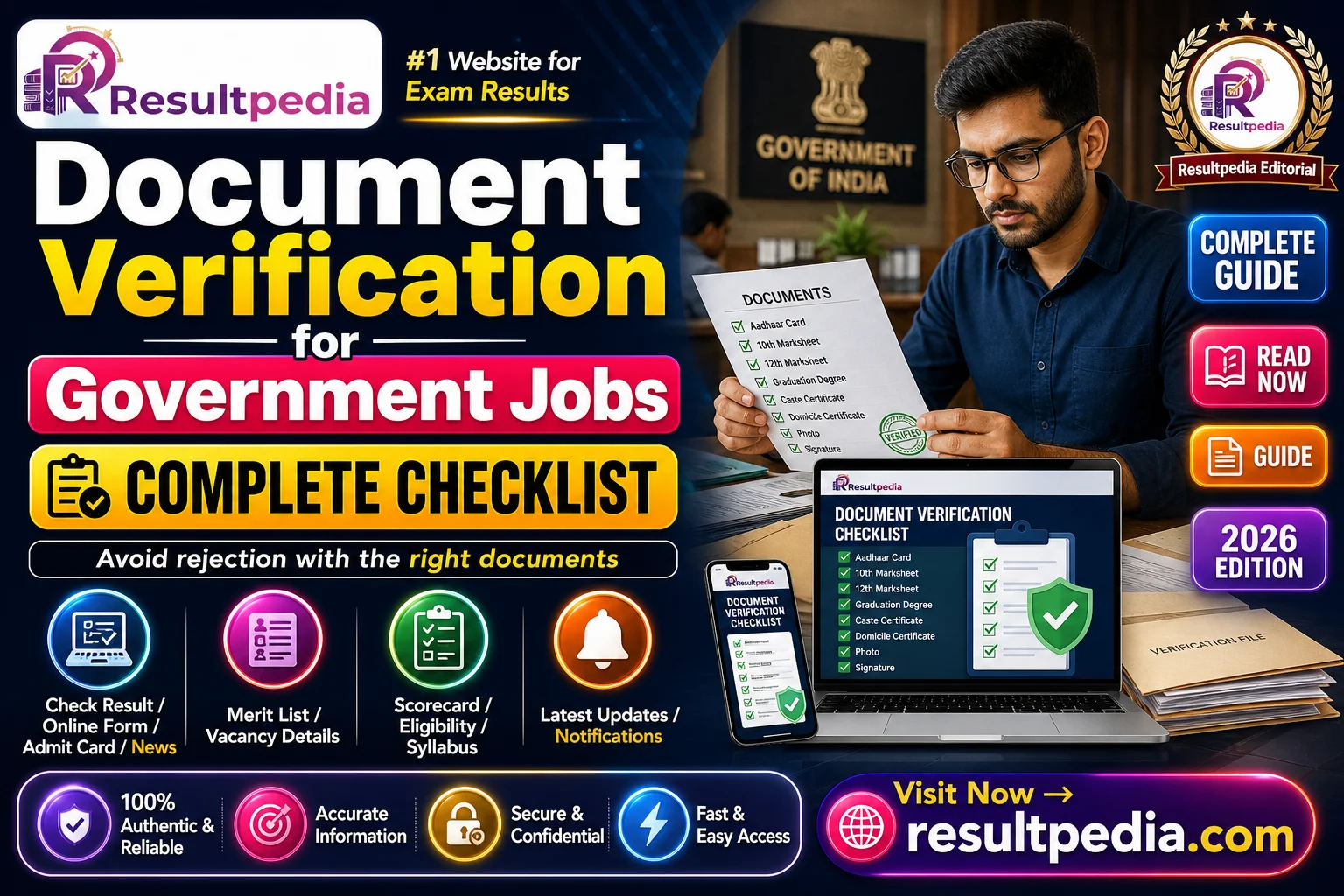
Document Verification is the stage where the recruiter checks your original documents against what you claimed in the form, usually after the written result. Selection stays provisional until DV is passed — a name mismatch, an expired category certificate or a missing original can undo a rank you earned. Carry originals plus self-attested photocopies of everything: education marksheets and certificates, date-of-birth and photo ID, category, EWS, PwBD and domicile certificates if claimed, the admit card, photographs, and an NOC if you are already in government service. The exact list varies by recruiter, so your DV call letter is the authority. This checklist covers what to carry and the mistakes that most often cause rejection.
By Muskaan Chauhan, Senior Editor — Strategy & Prep. Published 8 July 2026. Last verified 8 July 2026.
In short
- Document Verification (DV) is the stage where the recruiter checks your original documents against what you claimed in the form — usually after you clear the written exam or result.
- Selection stays provisional until DV is passed: a name mismatch, an expired category certificate, or a missing original can undo a rank you worked hard for.
- Carry originals plus a set of self-attested photocopies of everything — education, date of birth, category, identity, the admit card and photographs.
- The exact list varies by recruiter, so your DV call letter is the authority — take everything it names, and take a few extra photocopies to be safe.
Every recruitment season, candidates clear the exam only to stumble at Document Verification — not because they are ineligible, but because a document did not match, had expired, or was left at home. DV is the one stage where preparation means paperwork, not study. This checklist walks through what to carry and the mistakes that most often cause problems, so a document slip never costs you a seat.
What is Document Verification and when does it happen?
Document Verification (DV) is the stage where the recruiting body physically checks your original certificates to confirm you actually meet the eligibility — age, qualification, category — that you declared in your application. It usually comes after the written result or merit list and before final appointment. Until you clear DV, your selection is provisional: the offer depends on your documents proving what your form said.
The core document checklist
Take originals and at least two sets of self-attested photocopies of each. Your DV call letter is the final authority, but the standard set is:
Education
- Class 10 (Matriculation) marksheet and certificate — usually the primary proof of name and date of birth.
- Class 12 marksheet and certificate.
- Graduation / post-graduation degree and marksheets (if the post requires it).
- Diploma / professional qualification certificates, where relevant.
Identity and date of birth
- A government photo ID — Aadhaar, Voter ID, PAN, Driving Licence or Passport.
- Date-of-birth proof (the Class 10 certificate usually serves this).
Category and special certificates (if you claimed a benefit)
- Caste / category certificate (SC / ST / OBC) in the prescribed format and current validity.
- OBC non-creamy-layer certificate, if you applied under OBC — see our guide on the OBC NCL certificate and income limit.
- EWS certificate, if you applied under EWS — see the EWS certificate guide.
- PwBD / disability certificate, if you claimed a disability benefit.
- Domicile / residence certificate for state jobs — see our domicile certificate guide.
- Ex-servicemen, sportsperson or other special-category proof, if claimed.
Recruitment-specific
- The admit card / e-call letter and, where issued, the DV call letter.
- Recent passport-size photographs (same as on the application).
- Experience certificates, if the post requires prior experience.
- A No Objection Certificate (NOC) from your current employer, if you are already in government service.
Originals vs photocopies — get this right
The recruiter checks the originals and retains the self-attested photocopies. So:
- Bring every original — verification cannot be completed without them.
- Bring multiple self-attested photocopies (sign each one) — usually two sets is safe.
- Do not submit originals unless specifically asked; they are for inspection.
- Carry documents in a neat folder, organised in the order the call letter lists them.
The mistakes that most often cause rejection at DV
- Name mismatch across documents. If your name is spelled differently on your Class 10 certificate, category certificate and ID, it raises a flag. Sort out any variation (through the correct affidavit/correction process) before DV, not on the day.
- An expired or wrong-format category certificate. OBC non-creamy-layer certificates in particular have a validity period and a prescribed central/state format — an old or wrong-format certificate is a common rejection cause.
- A missing original. A photocopy alone is not enough; a single missing original can stall your verification.
- Date-of-birth inconsistency. Recruiters treat the Class 10 certificate as the authority; make sure every other document agrees with it.
- No NOC for in-service candidates. If you already work for a government body, the absence of an NOC can hold up your candidature.
What to do if a document is missing or a detail differs
If an original is genuinely unavailable or a detail differs, do not hide it — check the DV call letter and contact the recruiting body for the correct procedure (a provisional undertaking, a correction affidavit, or a deadline to produce the document). Recruiters usually have a defined process; what causes rejection is a mismatch discovered on the day with no explanation, not an honestly-flagged gap handled through the right channel.
Before you go — a quick pre-DV routine
- Read the DV call letter twice and list every document it names.
- Gather originals and make two self-attested photocopy sets of each.
- Cross-check names and dates of birth across all documents for consistency.
- Confirm category and domicile certificates are in the right format and still valid.
- Organise the folder in the call-letter order, add spare photographs, and keep your admit card on top.
Clearing DV turns a provisional selection into a real one — so treat the paperwork with the same seriousness you gave the exam.