
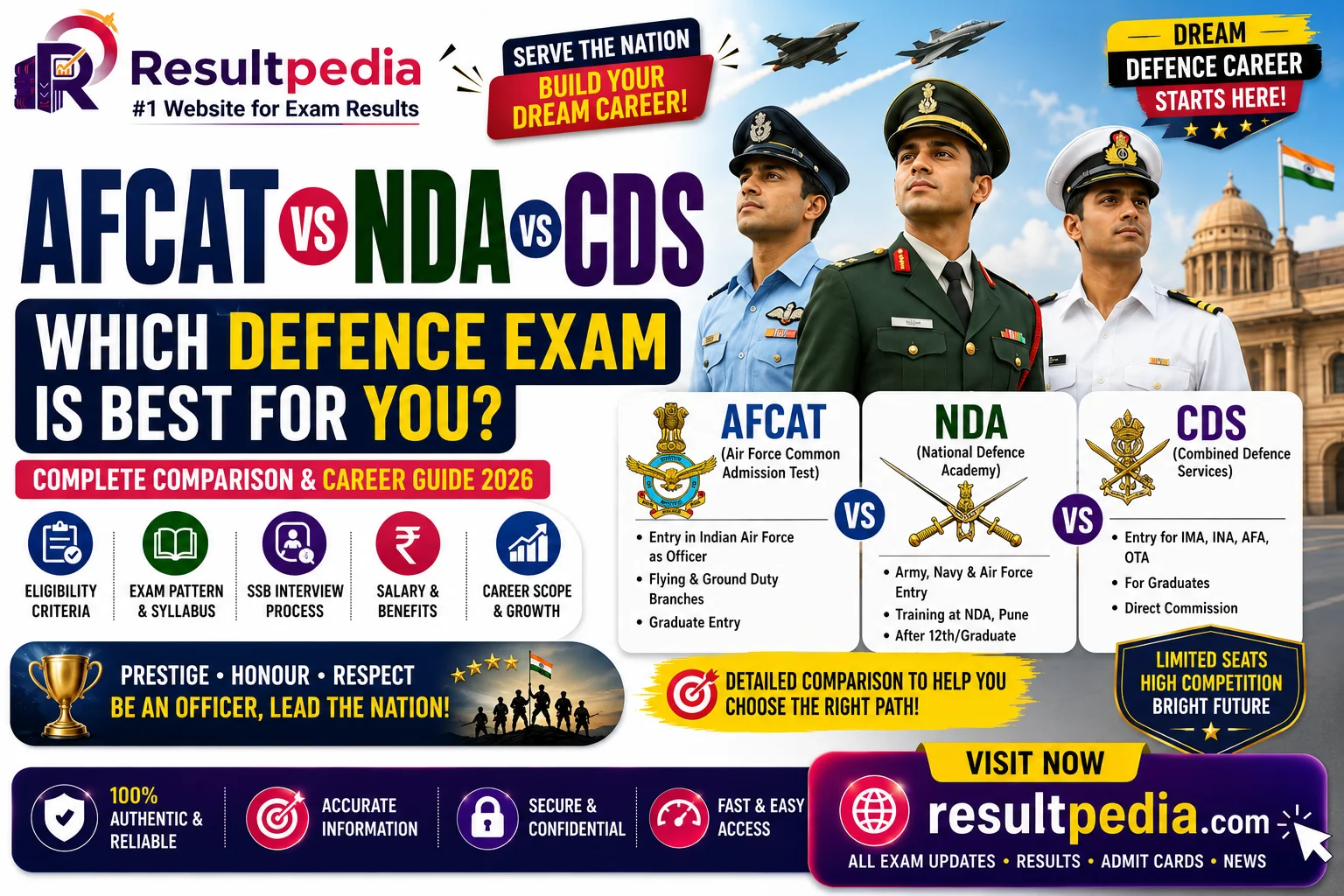
NDA, CDS, and AFCAT are three different doors to a commissioned officer role in the armed forces. NDA is for school leavers after 12th (tri-service), CDS is for graduates across all three services, and AFCAT is the Air Force-only graduate route. This guide compares eligibility, age, services, and how to choose.
By Pawan, Senior Editor — Defence & Railway desk. Published 22 May 2026. Last verified 22 May 2026 against NDA, CDS, and AFCAT eligibility patterns.
TL;DR
- These are three different doors to an officer's commission in the armed forces — pick by your stage of study.
- NDA: apply right after 12th (age ~16.5–19.5), tri-service, conducted by UPSC. Air Force/Navy wings need Physics + Maths.
- CDS: for graduates (age ~19–25), conducted by UPSC, leading to the IMA, INA, AFA, or OTA academies.
- AFCAT: Air Force only, for graduates, conducted by the IAF, for flying and ground-duty branches.
- Choose by qualification: in school → NDA; graduate wanting any service → CDS; graduate set on the Air Force → AFCAT.
If your goal is to become a commissioned officer in the Indian armed forces, NDA, CDS, and AFCAT are the three main entry exams — and the right one depends on where you are in your education and which service you want. This guide compares them so you target the correct door. For the live cycle, see the AFCAT 2026 page and the Defence Jobs hub.
Quick comparison
| NDA | CDS | AFCAT | |
|---|---|---|---|
| Stage | After 12th | After graduation | After graduation |
| Age (typical) | 16.5–19.5 | 19–25 | 20–24 (flying), 20–26 (ground) |
| Services | Army, Navy, Air Force | Army, Navy, Air Force | Air Force only |
| Conducted by | UPSC | UPSC | Indian Air Force |
| Academies | NDA Khadakwasla → service academy | IMA / INA / AFA / OTA | AFA Hyderabad |
NDA — the after-12th tri-service route
The National Defence Academy exam is the entry for school leavers: you can apply while in or just after Class 12 (age ~16.5–19.5), and it leads to all three services. The Army wing accepts any stream, but the Air Force and Naval wings require Physics and Mathematics at 10+2. Selected candidates train at the NDA in Khadakwasla before moving to their service academy. NDA is the youngest entry point and the longest officer-training pipeline, ideal if you are certain about a defence career early. It is conducted by UPSC with a written exam followed by the SSB interview.
CDS — the graduate route to all three services
The Combined Defence Services exam is for graduates (age ~19–25, varying by academy) and is also conducted by UPSC. Based on your choice and performance, it leads to the Indian Military Academy (IMA) for the Army, the Indian Naval Academy (INA), the Air Force Academy (AFA), or the Officers Training Academy (OTA) for the Short Service Commission. Different academies have different age and qualification specifics — for example, the Air Force entry through CDS expects Physics and Maths. CDS suits graduates who want a permanent commission across services.
AFCAT — the Air Force-only graduate route
The Air Force Common Admission Test is conducted by the Indian Air Force itself (not UPSC) and recruits graduates for flying and ground-duty (technical and non-technical) branches. Eligibility typically needs a bachelor's degree with around 60%, and the flying and technical branches require Physics and Maths at 10+2 (and relevant engineering for technical). Age is roughly 20–24 for the flying branch and 20–26 for ground duty. If you are a graduate set specifically on an Air Force career, AFCAT is your direct route, and it runs more frequently than the once-a-year academy entries.
Which one should you choose?
It comes down to your stage and service preference. Still in school? NDA is your route — and if you want the Air Force or Navy wing, take Physics and Maths. A graduate open to any service? CDS gives you the widest choice of academies and a permanent commission. A graduate set on the Air Force? AFCAT is the most direct, frequent option. All three culminate in the SSB interview, which tests officer-like qualities, so alongside the written preparation, work on the SSB from early — it is where many written-qualified candidates are filtered. For other defence and uniformed options, see best government jobs after 12th.
AFCAT vs NDA vs CDS: हिंदी सारांश
सशस्त्र बलों में अफसर बनने के तीन मुख्य रास्ते हैं, और सही चुनाव आपकी पढ़ाई के चरण पर निर्भर करता है। NDA: 12वीं के बाद (उम्र ~16.5–19.5), तीनों सेनाओं के लिए, UPSC द्वारा; एयरफोर्स/नेवी विंग के लिए फिजिक्स+मैथ्स ज़रूरी। CDS: ग्रेजुएट्स के लिए (उम्र ~19–25), UPSC द्वारा, जो IMA/INA/AFA/OTA अकादमियों तक ले जाता है। AFCAT: केवल एयरफोर्स के लिए, ग्रेजुएट्स हेतु, स्वयं भारतीय वायुसेना द्वारा संचालित (फ्लाइंग 20–24, ग्राउंड ड्यूटी 20–26)। स्कूल में हैं तो NDA; किसी भी सेना के इच्छुक ग्रेजुएट CDS; एयरफोर्स के इच्छुक ग्रेजुएट AFCAT चुनें। तीनों में अंत में SSB इंटरव्यू होता है। लाइव जानकारी के लिए AFCAT 2026 देखें।