
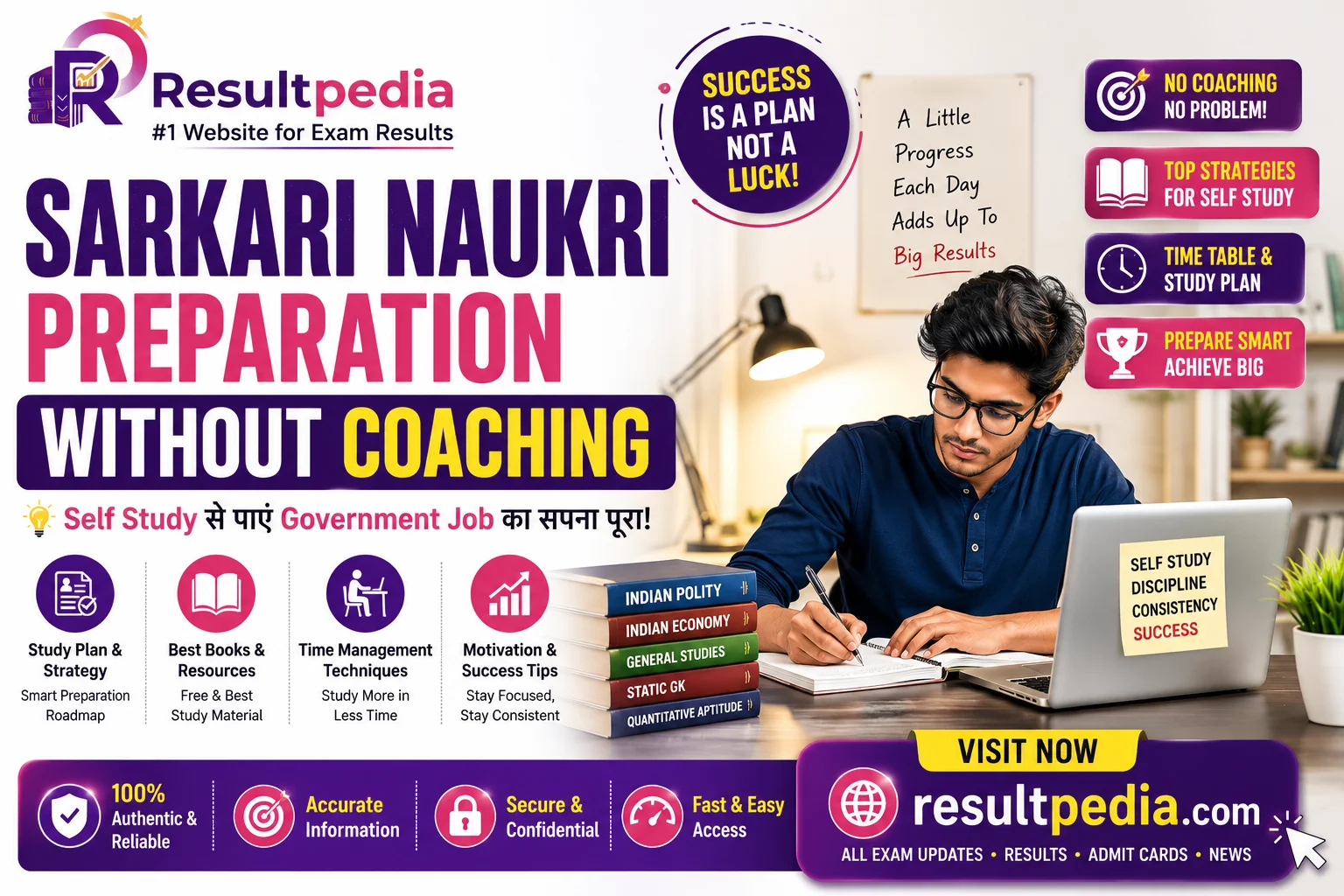
Most government exams can be cleared without coaching — they reward discipline and the right resources more than expensive classes. This realistic self-study roadmap covers starting from the official syllabus and PYQs, using one source per subject, building a daily routine, and making mocks the core of preparation.
By Saurabh Kamal, State PSC & Education Editor. Published 22 May 2026. Last verified 22 May 2026.
TL;DR
- Most government exams can be cleared without coaching — they test discipline and the right resources more than expensive classes.
- Start from the official syllabus and previous-year questions (PYQs) — they define exactly what to study and stop you over-preparing.
- Build a fixed daily routine, a single source per subject, and a regular mock-test habit with an error log.
- Use free and low-cost resources — NCERTs, official notifications, free mock platforms, and standard reference books — over scattered paid material.
- Coaching can help with doubt-solving and structure, but self-discipline is the real differentiator — many toppers are self-taught.
Coaching is helpful for some, but it is not a requirement to clear a government exam — thousands of selected candidates prepare entirely on their own. What they have in common is not a class but a system. This guide lays out a realistic self-study roadmap for any sarkari exam. Browse current vacancies on the Latest Jobs hub to anchor your target.
1. Start with the official syllabus and PYQs
Before buying a single book, download the official syllabus and several years of previous-year question papers for your target exam. The syllabus tells you the boundary of what to study; the PYQs tell you the depth and the recurring topics. Together they prevent the most common self-study mistake — studying too much of the wrong thing. Map every topic in the syllabus to how often it appears in PYQs, and you have an instant priority list.
2. One source per subject, not ten
The biggest trap in self-study is collecting material — ten PDFs, five YouTube channels, three books per subject. Pick one standard source per subject and finish it before adding anything. For most exams, NCERTs build the conceptual base, a single standard reference adds exam depth, and a current-affairs monthly compilation covers the dynamic part. Depth of revision beats breadth of collection every time.
3. Build a fixed daily routine
Consistency is the entire game in self-study. Set a realistic daily schedule you can sustain — even 3–4 focused hours daily beats erratic 10-hour bursts. Alternate subjects across the week, attach a short revision slot to each day, and protect the routine on low-motivation days. A working aspirant's routine looks different from a full-time one, but both win on showing up daily, not on heroic single sessions.
4. Make mocks and PYQs the core, not the extra
Self-taught toppers treat mock tests as the syllabus, not a checkpoint. From the practice phase, take regular sectional and full-length mocks under timed conditions, then spend as long analysing them as taking them. Maintain an error log — every wrong answer with the reason (concept gap, silly mistake, or time pressure) — and revise it instead of starting new chapters in the final weeks. Free and low-cost mock platforms make this entirely doable without coaching.
5. Use free resources and a small community
You do not need paid classes for content. NCERTs, official notifications and syllabi, free mock platforms, standard reference books, and quality educational channels cover almost everything. What self-study lacks is doubt-solving and accountability, so build a small study group or online community to clear doubts and stay motivated. This replaces the two genuine benefits of coaching — structure and peer pressure — at near-zero cost.
When coaching does help
Coaching is worth it if you struggle with self-discipline, need structured doubt-solving in a tough subject (like RBI Grade B finance or a UPSC optional), or want a ready-made schedule. But it is not a substitute for the daily work — even the best coaching fails for a candidate who does not revise and practise. If you have the discipline to follow the roadmap above, self-study is not just possible; it is how a large share of selected candidates actually prepare. For exam-specific plans, see our SSC CGL preparation plan and RBI Grade B strategy.
बिना कोचिंग सरकारी नौकरी की तैयारी: हिंदी सारांश
ज़्यादातर सरकारी परीक्षाएँ बिना कोचिंग पास की जा सकती हैं — ये महंगी क्लास से ज़्यादा अनुशासन और सही संसाधनों की परीक्षा हैं। आधिकारिक सिलेबस और पिछले वर्षों के प्रश्नपत्र (PYQs) से शुरू करें — यही बताते हैं कि क्या और कितना पढ़ना है। हर विषय के लिए एक ही स्रोत चुनें, एक निश्चित दैनिक दिनचर्या बनाएँ, और नियमित मॉक टेस्ट + error log को तैयारी का केंद्र बनाएँ। NCERT, फ्री मॉक प्लेटफॉर्म, मानक किताबें अधिकांश ज़रूरत पूरी करते हैं; doubt-solving व प्रेरणा के लिए छोटा study group बनाएँ। कोचिंग संरचना व doubt-solving में मदद करती है, पर असली फर्क स्व-अनुशासन लाता है। परीक्षा-विशेष योजना के लिए SSC CGL preparation plan पढ़ें।