
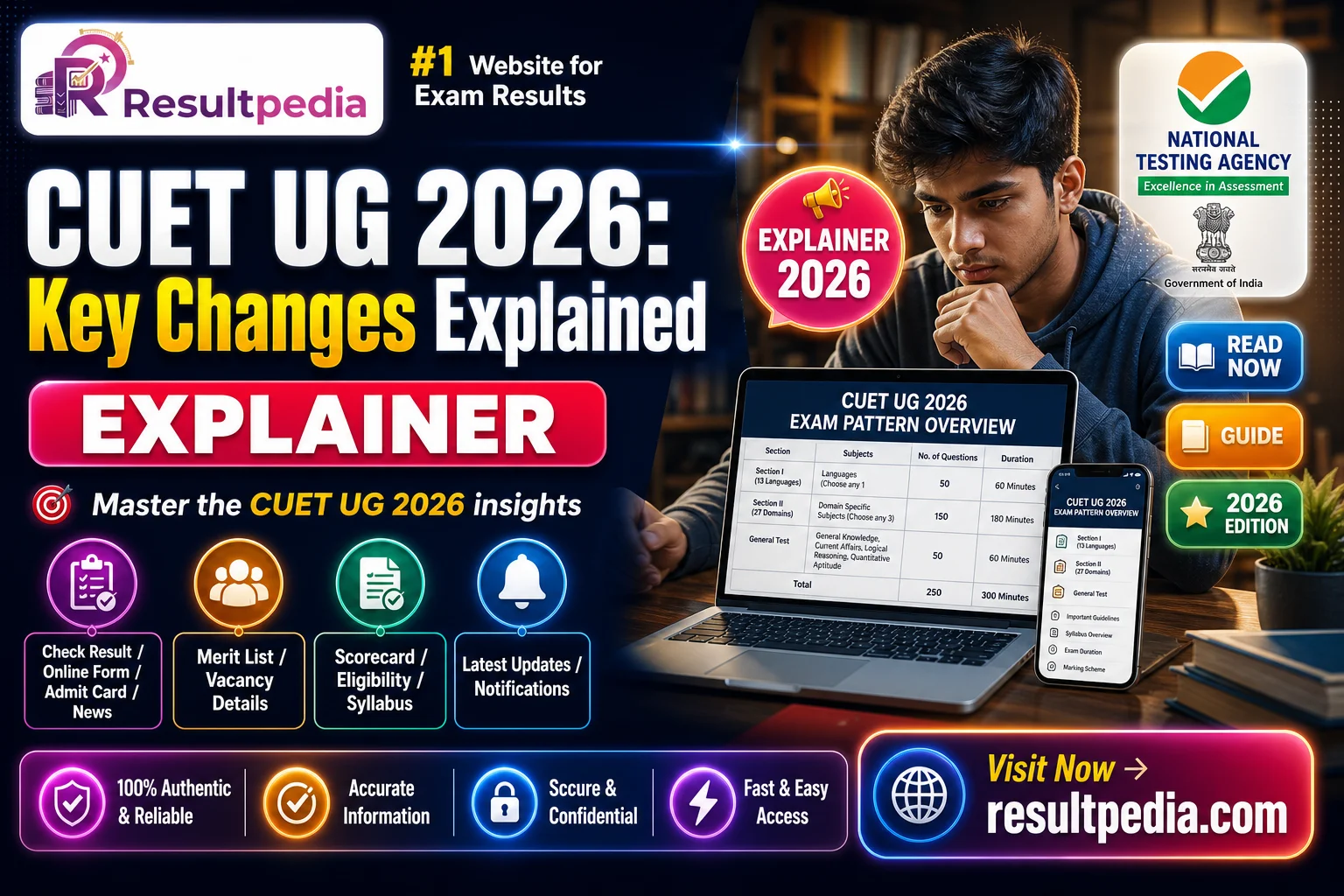
CUET UG is the single computer-based entrance test most central universities, and many state, deemed and private ones, use for undergraduate admission, conducted by the NTA. The 2026 cycle ran in CBT mode in late May over multiple days and shifts. It has three sections — Languages, Domain subjects and a General Test — each tested section with 50 MCQs marked +5 for correct and −1 for wrong, so a subject is out of 250. Two 2026 changes matter: domain subjects were reduced from 27 to 23, and candidates can now choose subjects they did not study in Class 12. Scores are normalised across shifts, and each university then applies its own cut-offs and subject mapping.
By Saurabh Kamal, State PSC & Education Editor. Published 18 June 2026. Last verified 18 June 2026.
In short
- CUET UG is the single computer-based entrance test that most central universities — and a large number of state, deemed and private ones — use for undergraduate admission, conducted by the NTA.
- The 2026 cycle ran in CBT mode in late May 2026 across multiple days and shifts.
- The test has three sections: Languages, Domain subjects and a General Test. Each tested section has 50 MCQs, marked +5 for correct and −1 for wrong, so a subject is out of 250.
- Two 2026 changes matter: domain subjects were trimmed from 27 to 23, and candidates can now pick subjects they did not study in Class 12.
For lakhs of Class 12 students, CUET UG has replaced a pile of separate college entrance tests with one common exam. That is a big convenience, but it also means one test now carries a lot of weight, so understanding its structure is the difference between picking the right subjects and wasting a section. This explainer breaks down how CUET UG is built, how it is marked, and what changed in the 2026 cycle, so you can read your scorecard — or plan your attempt — without guesswork.
What CUET UG is
CUET UG (Common University Entrance Test, Undergraduate) is a national entrance test conducted by the National Testing Agency. A strong CUET score is the gateway to undergraduate programmes at central universities such as Delhi University, BHU, JNU and Jamia Millia Islamia, and at a growing list of state, deemed and private universities that accept the score. Instead of sitting half a dozen college-specific exams, a student takes CUET once and applies to multiple universities with that result.
The three sections
CUET UG is organised into three parts, and you choose which to attempt based on the courses you are targeting.
| Section | What it tests | Questions | Notes |
|---|---|---|---|
| Section I — Languages | A language of your choice | 50 MCQs | 13 languages offered (English, Hindi, and regional languages) |
| Section II — Domain | School subjects (e.g. Physics, Accountancy, History) | 50 MCQs each | Subject count reduced from 27 to 23 in 2026 |
| Section III — General Test | GK, current affairs, reasoning, basic maths | 50 MCQs | Required mainly for general/interdisciplinary programmes |
You do not attempt every subject — you select the languages, domain subjects and the General Test as required by the specific university courses you want, so plan your subject choices around your target colleges.
Marking scheme
The marking is uniform and strict, which makes accuracy more valuable than raw attempts:
- +5 marks for every correct answer.
- −1 mark for every wrong answer.
- A tested subject of 50 questions is therefore out of 250 marks.
Because each wrong answer costs a mark, blind guessing hurts. With this scheme, leaving a genuinely unknown question blank is often smarter than a random guess, and educated elimination is worth the risk only when you can rule out options confidently.
What changed in 2026
Two updates stand out this cycle:
- Domain subjects trimmed from 27 to 23. A few subjects were consolidated or removed, so candidates had to confirm their chosen domain subjects were still on the 2026 list.
- You can choose subjects you did not study in Class 12. Under the UGC's flexibility rule, a student is no longer strictly locked to their Class 12 stream for every CUET subject. This opens cross-stream options — for example, a commerce student attempting a domain subject outside their board combination — though individual universities can still set their own eligibility for a programme.
Both changes push in the same direction: more flexibility for the student, but more responsibility to check each target university's specific requirements before locking subject choices.
How CUET scores turn into admission
A common misunderstanding is that CUET "ranks" you nationally for a seat. In practice, the NTA releases your scores (often normalised across shifts, since the exam runs over many days), and then each university uses those scores for its own admission process — its own cut-offs, its own subject-mapping for each course, and in some cases its own additional criteria. So two students with the same total can have very different outcomes depending on which subjects they took and which universities those map to. If the idea of score normalisation across shifts is new to you, it is the same fairness mechanism used in many large exams, and it explains why your scaled score can differ from your raw marks.
Common mistakes to avoid
- Picking the wrong subjects for the course. Each programme maps to specific CUET subjects. Choosing a subject the course does not count wastes a slot.
- Ignoring the General Test when a course needs it. Some interdisciplinary and BA programmes weight Section III heavily.
- Guessing carelessly under a −1 scheme.
- Not checking each university separately. CUET is one test, but admission rules are set college by college.
Where CUET fits in your bigger plan
A degree through CUET is a starting point, not the finish line. Many students who take CUET are also weighing what comes after graduation — a government career, a private one, or further study. If that is you, it is worth looking early at the best government jobs you can target after Class 12 and the highest-paying government jobs for graduates, so your degree choice lines up with where you want to end up. The broader trade-off between a stable public-sector path and a private one is covered in government job versus private job in 2026. And to see what is actually open right now, browse the jobs board.
CUET UG 2026: हिंदी सारांश
CUET UG एक ही कंप्यूटर-आधारित प्रवेश परीक्षा है जिसके माध्यम से अधिकांश केंद्रीय विश्वविद्यालय और कई राज्य/डीम्ड/निजी विश्वविद्यालय स्नातक प्रवेश देते हैं; इसे NTA आयोजित करती है। 2026 चक्र CBT मोड में मई 2026 के अंत में कई दिनों व शिफ्टों में हुआ। परीक्षा में तीन खंड हैं — भाषा, डोमेन विषय, और सामान्य परीक्षण — प्रत्येक परीक्षित खंड में 50 MCQ, अंकन +5 सही / −1 गलत, यानी प्रति विषय 250 अंक। 2026 के दो बड़े बदलाव: डोमेन विषय 27 से घटाकर 23 किए गए, और अभ्यर्थी अब कक्षा 12 में न पढ़े गए विषय भी चुन सकते हैं (UGC लचीलापन नियम)। स्कोर सामान्यीकृत (normalised) होते हैं, और हर विश्वविद्यालय अपनी कट-ऑफ व विषय-मानचित्रण के अनुसार प्रवेश देता है — इसलिए हर लक्ष्य कॉलेज की शर्तें अलग से जाँचें।