
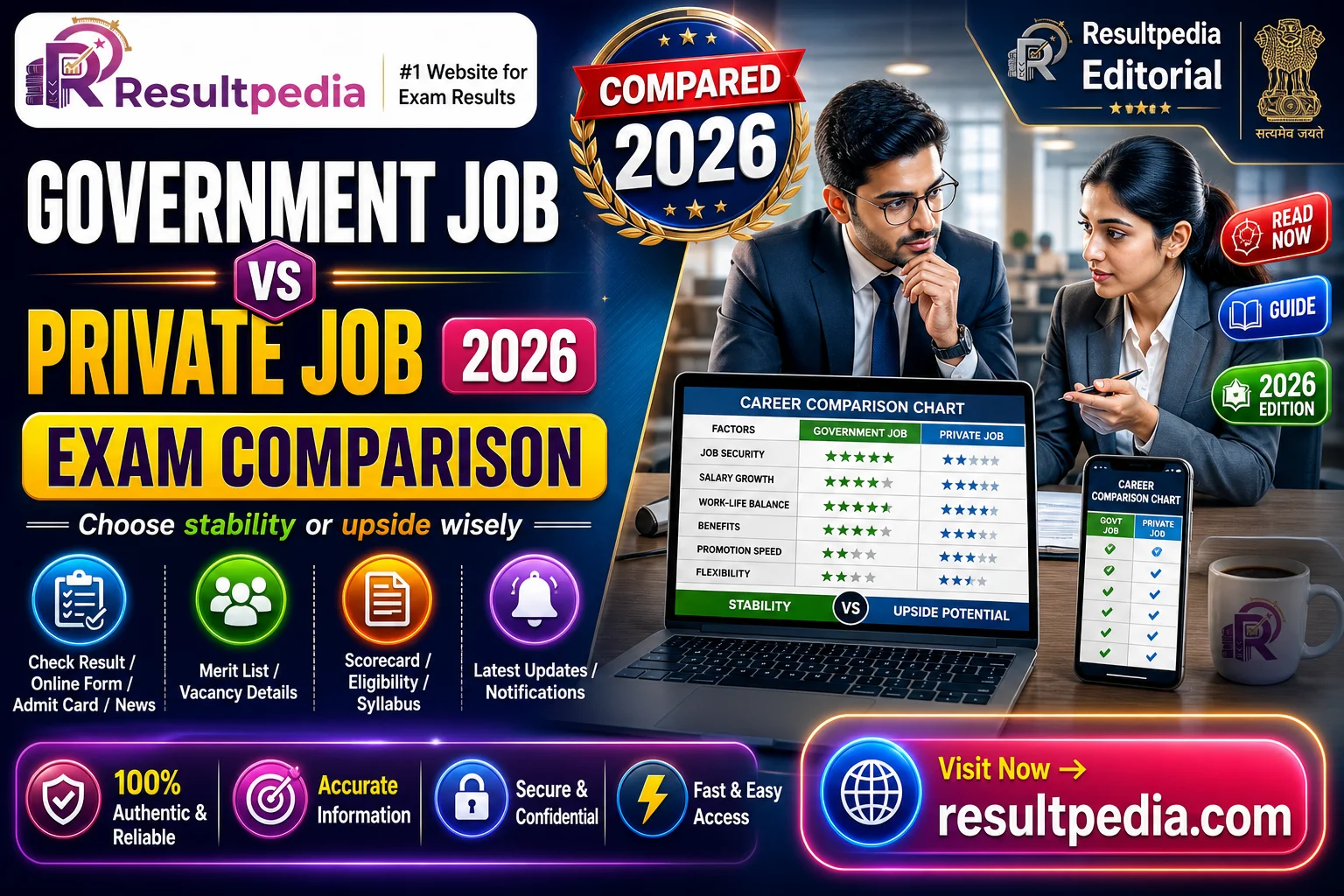
Government and private jobs each win on different things: government on security, predictable pay and work-life balance; private on earning ceiling and speed of growth for strong performers. This guide compares the two honestly on pay, security, growth and lifestyle so you can choose by what you value.
By Saurabh Kamal, Careers Editor. Published 15 June 2026. Last verified 15 June 2026.
In short
- A government job wins on security, predictable pay (with DA and HRA), pension (NPS), and work-life balance.
- A private job wins on earning ceiling and speed of growth for strong performers, but with market-dependent security.
- Government growth is time-bound and exam-driven; private growth is performance-driven and faster at the top end.
- The right answer is not universal — it depends on whether you value stability or upside.
"Government job or private job?" is one of the most common career questions in India, and most answers are biased one way or the other. The honest truth is that each wins on different things. This guide compares the two on the four factors that actually decide it — pay, security, growth and work-life — so you can choose by what you value, not by what someone else preferred.
The honest trade-off
| Factor | Government job | Private job |
|---|---|---|
| Job security | Very high | Market-dependent |
| Pay (start) | Moderate, predictable | Wide range — can be higher |
| Pay growth | Time-bound, steady (DA, increments) | Performance-driven, can be steep |
| Pension / retiral | NPS + retiral benefits | EPF / gratuity |
| Work-life | Generally fixed hours, good leave | Varies widely by company |
| Growth path | Exams + seniority | Performance + switching |
Neither column is "better" outright — they are simply strong on different things.
Pay: predictable vs uncapped
A government salary is predictable and protected — a fixed pay scale, regular increments, Dearness Allowance that rises with inflation, House Rent Allowance, and other allowances. It rarely falls, and it does not depend on a company's fortunes. A private salary has a wider range: the ceiling is higher, especially in tech, finance, consulting and sales, and a strong performer can out-earn a government peer significantly. But it is also more variable — tied to the company, the sector cycle, and your individual performance. The highest-paying government routes are mapped in the highest-paying options for graduates.
Security: the biggest divide
This is where government jobs are simply in a different league. A government post offers near-total job security — layoffs are rare and the role is stable through economic downturns. A private job's security depends on the market: hiring and firing track the business cycle, and even good performers can be affected by restructuring. If certainty of income is your priority — for family responsibilities, a home loan, or simple peace of mind — this single factor often decides it.
Growth: seniority vs performance
The two grow differently. Government growth is structured and time-bound — you move up by a mix of seniority and departmental exams, which is steady and fair but rarely sudden. Private growth is performance-driven: a high performer can be promoted fast, take on bigger roles, and accelerate pay by switching companies. So if you want a predictable, stress-light climb, government suits you; if you want to move as fast as your results allow, private rewards that more directly.
Work-life and pension
Government jobs generally offer fixed hours, defined leave and a calmer pace, which many people value highly over a long career, plus retiral benefits through the National Pension System (NPS). Private work-life varies enormously — some companies are balanced, others demanding — and retirement saving is usually through EPF and gratuity. If lifestyle and stability matter more than maximum income, this tilts toward government.
So which should you choose?
- Value security, predictability and balance? Lean government — and if you are deciding which government stream, if you've already decided on government, here's how three big streams compare.
- Value maximum earning and fast growth, and can handle market risk? Lean private.
- Many people do both in sequence — a few years in private for skills and savings, then a government job for stability, or the reverse. If you are preparing for a government exam on a budget, preparing without expensive coaching shows it can be done. Either way, browse the full jobs board to see what is open right now.
Government vs Private Job: हिंदी सारांश
सरकारी और निजी नौकरी अलग-अलग चीज़ों में बेहतर हैं। सरकारी नौकरी सुरक्षा, निश्चित वेतन (DA/HRA सहित), पेंशन (NPS) तथा बेहतर कार्य-जीवन संतुलन में आगे है। निजी नौकरी अच्छे प्रदर्शन करने वालों के लिए अधिक कमाई व तेज़ विकास देती है, परंतु इसकी सुरक्षा बाज़ार पर निर्भर है। सरकारी विकास वरिष्ठता व विभागीय परीक्षाओं से होता है (स्थिर पर धीमा), जबकि निजी विकास प्रदर्शन-आधारित व तेज़ हो सकता है। सही चुनाव सार्वभौमिक नहीं — यह इस पर निर्भर करता है कि आप स्थिरता चाहते हैं या अधिक संभावना। कई लोग दोनों को क्रमवार अपनाते हैं — कुछ वर्ष निजी क्षेत्र में अनुभव/बचत, फिर सरकारी नौकरी की स्थिरता।