
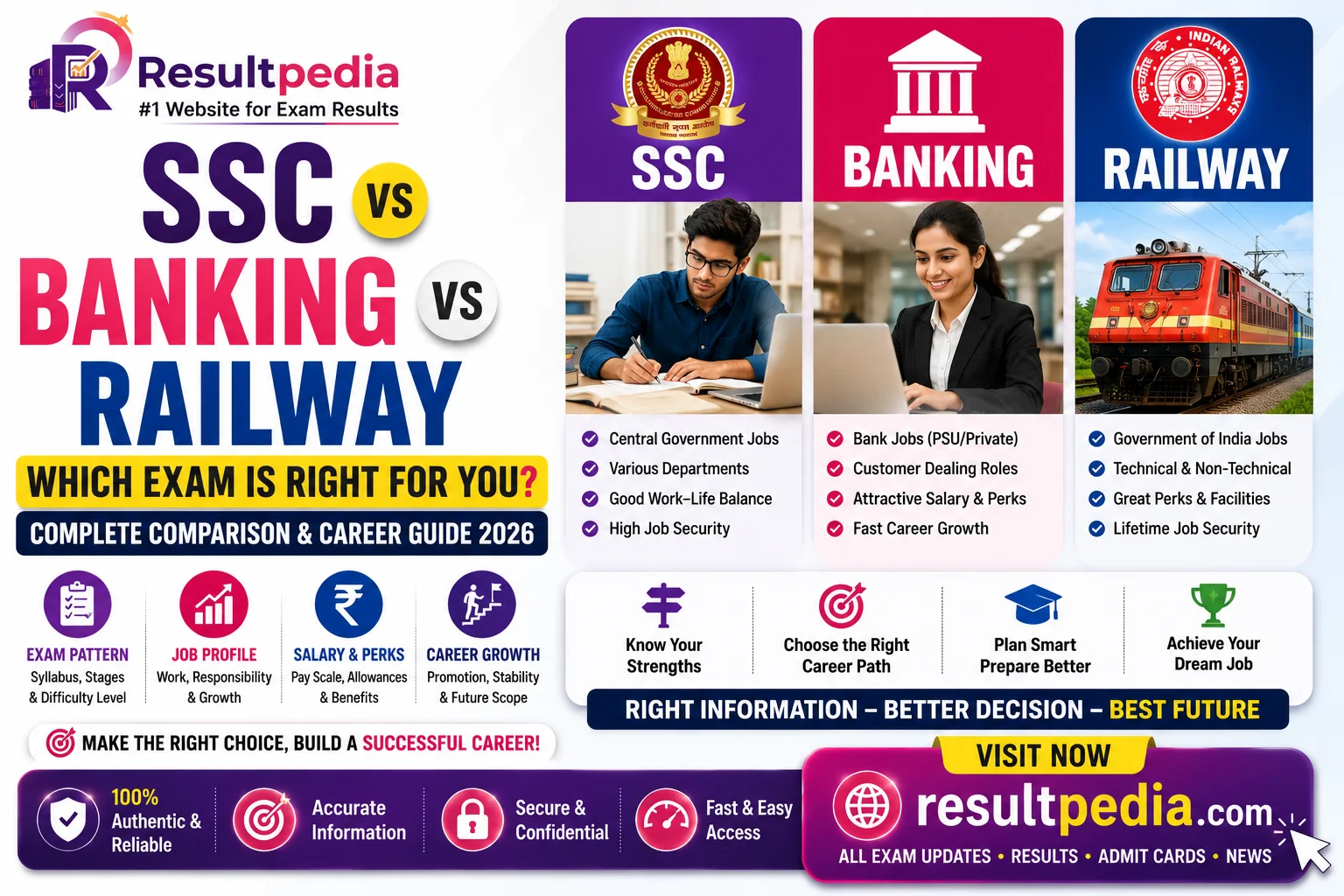
SSC, banking, and railways are the three biggest government-exam streams, each leading to different work, pay, and lifestyle. This guide compares them on role type, pay ceiling, qualification range, and lifestyle so you choose deliberately rather than by which seems easiest.
By Vishal Thakur, Senior Editor — Central Recruitment desk. Published 22 May 2026. Last verified 22 May 2026.
TL;DR
- SSC, Banking, and Railways are the three biggest government-exam streams — pick by the work, pay ceiling, and lifestyle you want, not by which is "easiest".
- SSC → central-government desk and enforcement roles (CGL, CHSL, GD, MTS); strong mix of pay and stability.
- Banking → officer/clerk roles with the highest pay ceiling at the top (RBI Grade B) but target-driven, transfer-heavy commercial work.
- Railways → the widest scale and most posts, from 10th-level Group D to graduate NTPC and technical JE/ALP.
- The exam syllabuses overlap heavily (maths, reasoning, English, GA), so a common base lets you keep two streams open while you specialise.
"Should I prepare for SSC, banking, or railways?" is the most common question a government aspirant asks. There is no universal best — each stream leads to different work, pay, and life. This guide compares them on what actually matters so you choose deliberately. Browse all three on the SSC Jobs, Bank Jobs, and Railway Jobs hubs, or see everything live on the Latest Jobs hub.
The three streams at a glance
| SSC | Banking | Railways | |
|---|---|---|---|
| Main exams | CGL, CHSL, GD, MTS | IBPS PO/Clerk, SBI, RBI Grade B | NTPC, Group D, ALP, JE, Technician |
| Qualification range | 10th to graduate | Mostly graduate | 10th to graduate |
| Role type | Desk + enforcement | Commercial + regulatory | Operations + technical |
| Pay ceiling | High (AAO Level 8) | Highest (RBI Grade B) | High (JE, NTPC Graduate) |
| Lifestyle | Mostly stable postings | Target-driven, transfers | Varies (desk to field/running) |
SSC — central-government desk and enforcement
SSC recruits across central ministries: CGL for graduate Group B/C posts (Inspector, ASO, Auditor, AAO), CHSL for 12th-level clerical posts, and GD/MTS for uniformed and support roles. The appeal is a strong balance of pay, central-government stability, and varied roles — from an Income Tax Inspector's field work to a secretariat desk. If you want a central-government identity with mostly stable postings and a clear exam ladder, SSC fits. Start with our SSC CGL preparation plan.
Banking — the highest ceiling, commercial intensity
Banking spans IBPS and SBI PO/Clerk roles and the RBI Grade B officer post. It has the highest pay ceiling of the three at the top (RBI Grade B's CTC crosses ₹30 lakh), and offers fast growth in commercial banking. The trade-off is the nature of the work: targets, customer-facing pressure, and frequent transfers in commercial banks. RBI Grade B is the exception with a regulator's balance. If you want the highest pay and don't mind commercial intensity, banking is the route. Compare the roles in RBI Grade B vs IBPS PO vs SBI PO.
Railways — the widest scale and variety
Indian Railways is the single largest recruiter, with posts for every qualification: Group D (10th/ITI), NTPC (12th and graduate), and the technical ALP, JE, and Technician routes. The variety is unmatched — desk operations, station management, train operating, and engineering maintenance. If you want the widest range of entry points or a technical/operational career, railways offer the most doors. See RRB NTPC vs Group D vs ALP to navigate the options.
How to choose
Decide on three axes. Qualification: a graduate can target all three; a 12th-pass leans to SSC CHSL and railways; a 10th/ITI holder leans to railways. Work you want: desk/enforcement (SSC), commercial/regulatory finance (banking), operations/technical (railways). Pay vs lifestyle: highest ceiling with intensity (banking) versus stable variety (SSC, railways). Because the written syllabuses overlap so much — quantitative aptitude, reasoning, English, and general awareness — you can build one strong base and keep two streams open, then commit fully to the one whose role and life suit you. Avoid the trap of preparing for all three half-heartedly.
SSC vs Banking vs Railway: हिंदी सारांश
SSC, बैंकिंग और रेलवे तीन सबसे बड़ी सरकारी परीक्षा स्ट्रीम हैं — चुनाव "सबसे आसान" के आधार पर नहीं, बल्कि काम, वेतन सीमा और जीवनशैली के आधार पर करें। SSC → केंद्र सरकार के डेस्क व प्रवर्तन पद (CGL, CHSL, GD, MTS)। बैंकिंग → अधिकारी/क्लर्क पद, शीर्ष पर सबसे ऊँचा वेतन (RBI Grade B) पर target-driven व ट्रांसफर वाला काम। रेलवे → सबसे बड़ा पैमाना, 10वीं से ग्रेजुएट तक के पद। तीनों के सिलेबस काफी ओवरलैप करते हैं (गणित, रीज़निंग, अंग्रेज़ी, GA), इसलिए एक common base बनाकर दो स्ट्रीम खुली रखें और फिर एक पर पूरी तरह फोकस करें। सभी लाइव वैकेंसी के लिए Latest Jobs hub देखें।