
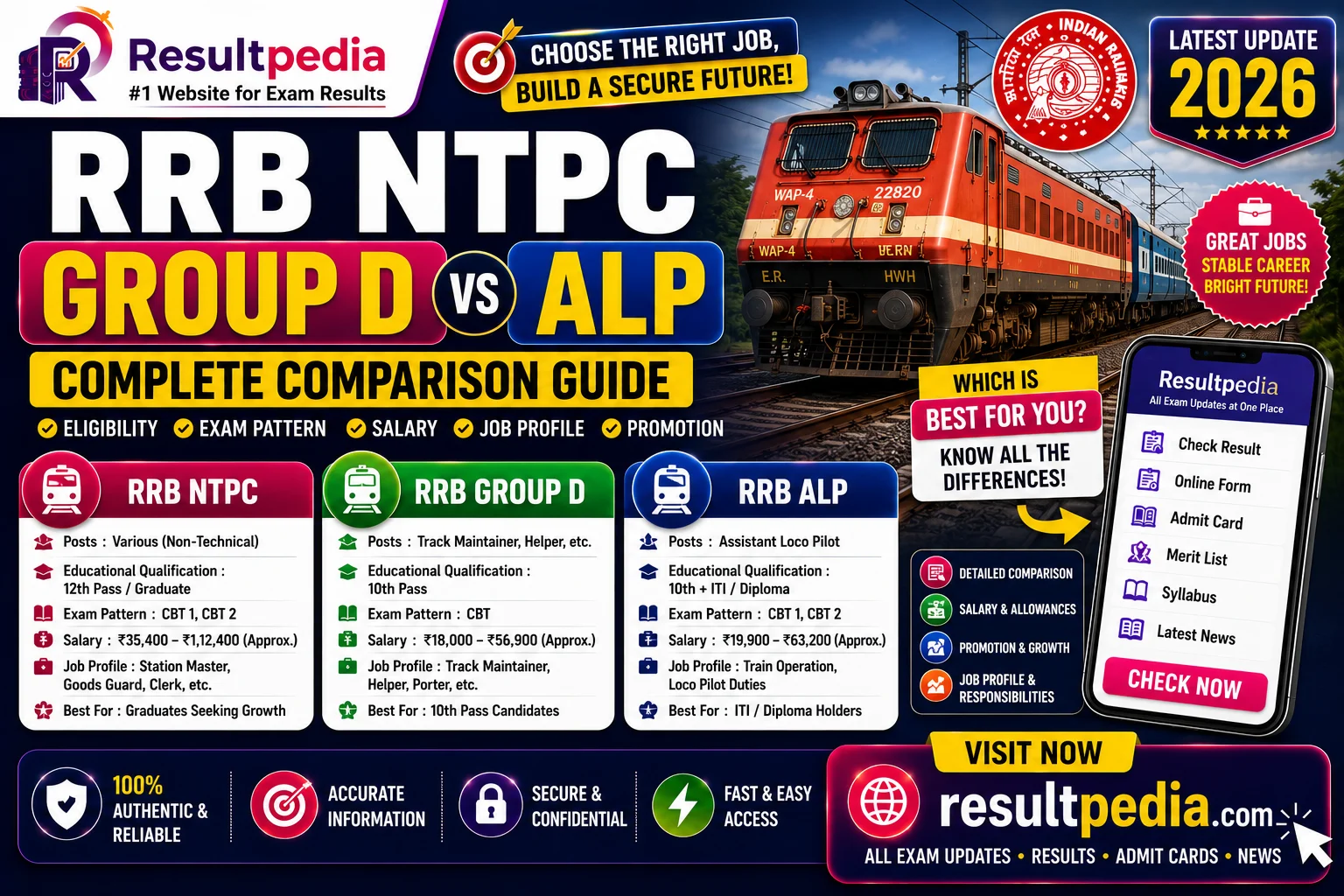
RRB NTPC, Group D, and ALP look similar but lead to very different careers, pay, and selection paths. This guide compares them on qualification, age, pay level, role type, and selection difficulty so you can target the one railway exam that fits you instead of spreading thin across all three.
By Pawan, Senior Editor — Defence & Railway desk. Published 22 May 2026. Last verified 22 May 2026 against the latest RRB Group D, ALP, and NTPC notification patterns.
TL;DR
- Pick by qualification first: only 10th/ITI → Group D or ALP; 12th → NTPC (UG); graduate → NTPC (Graduate).
- Group D is the widest door (10th pass, single CBT) but the lowest entry pay (Pay Level 1, basic ₹18,000).
- ALP is the highest-value 10th+ITI route — Pay Level 2 plus running-staff allowances push the real pay well above Group D, but the medical (A-1 vision) and the extra CBAT stage are strict.
- NTPC is the clerical/officer track — UG posts for 12th-pass, higher-paying Graduate posts (Station Master, Goods Train Manager) for graduates.
- There is no single "best" exam — there is the best fit for your qualification, age, and whether you want a desk role or a technical/field role.
If you are eyeing a railway job in 2026, the three big Railway Recruitment Board (RRB) exams — Group D, ALP, and NTPC — look similar from outside but lead to very different careers, pay, and selection paths. This guide compares them on the things that actually decide your choice, so you target one exam properly instead of spreading thin across all three. For every live railway vacancy, keep the Railway Jobs hub and the RRB NTPC 2026 pillar handy.
Quick comparison
| RRB Group D | RRB ALP | RRB NTPC | |
|---|---|---|---|
| Min qualification | 10th or ITI | 10th + ITI (relevant trade) / diploma | 12th (UG posts) / graduate |
| Age (typical) | 18–36 | 18–28 | 18–30 (UG), 18–33 (Graduate) |
| Pay level (7th CPC) | Level 1 | Level 2 | Level 2/3 (UG), 5/6 (Graduate) |
| Basic pay | ₹18,000 | ₹19,900 | ₹19,900 (UG) → ₹35,400 (Graduate) |
| Selection | 1 CBT → PET → DV → Medical | CBT-1 → CBT-2 → CBAT → DV → Medical | CBT-1 → CBT-2 → (typing/skill) → DV → Medical |
| Typical role | Track Maintainer, Pointsman, Helper | Assistant Loco Pilot (running staff) | Station Master, Clerk, Goods Train Manager |
In-hand pay depends on city and current DA; ALP and other running staff also earn mileage/running allowance that materially raises take-home.
RRB Group D — the widest entry door
Group D (Pay Level 1) is the most accessible railway exam: a 10th pass or ITI certificate qualifies you, the age window is the broadest (up to 36 with relaxations), and the selection is the simplest — a single computer-based test, followed by a Physical Efficiency Test (PET), document verification, and medical. The trade-off is pay: a basic of ₹18,000 means an in-hand of roughly ₹22,000–₹25,000 to start. The roles — Track Maintainer, Pointsman, Assistant/Helper across departments — are physical and field-based. If you want the fastest, lowest-barrier route into Indian Railways and are comfortable with field work, Group D is the call. Vacancies in recent cycles have run into the tens of thousands; check the official notice for the exact 2026 count.
RRB ALP — the best 10th+ITI value, with a stricter gate
The Assistant Loco Pilot (ALP) post is where a candidate with 10th plus an ITI in a relevant trade (Electrician, Fitter, Mechanic, Welder, etc.) — or a relevant diploma — gets the most value. It sits at Pay Level 2 (basic ₹19,900), but the real difference is that ALP is running staff: mileage and running allowances push take-home well past a comparable static post. The catch is a tougher path — CBT-1, CBT-2, and a Computer-Based Aptitude Test (CBAT) — plus a strict A-1 medical standard (sharp, correctable vision is non-negotiable for footplate duty). If you have the trade qualification, can clear the aptitude stage, and meet the vision standard, ALP is the strongest 10th+ITI career in this list. See the live RRB ALP 2026 form and the ITI Jobs hub.
RRB NTPC — the clerical and officer track
NTPC (Non-Technical Popular Categories) is the desk/operations track and splits by qualification. Undergraduate (10+2) posts — Commercial-cum-Ticket Clerk, Accounts Clerk, Junior Clerk, Trains Clerk — need a 12th pass and sit at Pay Level 2/3. Graduate posts — Station Master, Goods Train Manager, Senior Clerk, Junior Accounts Assistant — need a degree and pay considerably more (Pay Level 5/6, basic up to ₹35,400). NTPC selection runs CBT-1 → CBT-2, with a typing or skill test for relevant posts, then DV and medical. If you are a graduate, the NTPC Graduate posts are the highest-paying option among these three exams. The two NTPC cycles run under different notices — see our RRB NTPC vs Graduate/UG explainer and the live NTPC UG admit card and Graduate result pages.
How to choose — a simple decision path
- Start with your highest qualification. Only 10th/ITI? You are choosing between Group D and ALP. 12th? NTPC UG (and Group D). Graduate? NTPC Graduate is your highest-pay target, with the others as backups.
- Then weigh role type. Want a technical, running role with allowances? ALP. Prefer a clerical/operations desk? NTPC. Want the quickest entry with the least process? Group D.
- Check the hard gates. ALP's A-1 medical and CBAT eliminate many candidates — be honest about your vision and aptitude before committing your prep to it.
- Match the age window. ALP's tighter 18–28 band rules it out for some older candidates who still qualify for Group D or NTPC.
The biggest mistake aspirants make is applying to all three and preparing for none. The CBT syllabuses overlap (maths, reasoning, general awareness, general science), so build that common base — then specialise toward the one exam whose qualification, pay, and role fit you best.
RRB NTPC vs Group D vs ALP: हिंदी सारांश
रेलवे की तीनों बड़ी परीक्षाओं में से सही चुनाव सबसे पहले आपकी योग्यता से तय होता है। सिर्फ 10वीं/ITI है तो Group D या ALP; 12वीं है तो NTPC (UG); ग्रेजुएट हैं तो NTPC (Graduate) सबसे ज़्यादा वेतन वाला विकल्प है। Group D सबसे आसान प्रवेश है (Pay Level 1, बेसिक ₹18,000, एक ही CBT), पर वेतन सबसे कम। ALP (Pay Level 2) में रनिंग अलाउंस के कारण असली कमाई ज़्यादा है, लेकिन CBAT और सख्त A-1 मेडिकल पास करना ज़रूरी है। NTPC क्लर्क/ऑपरेशन ट्रैक है — ग्रेजुएट पोस्ट (स्टेशन मास्टर आदि) सबसे अच्छा वेतन देती हैं। तीनों का सिलेबस ओवरलैप करता है, इसलिए एक common base बनाकर एक ही परीक्षा पर फोकस करें।