
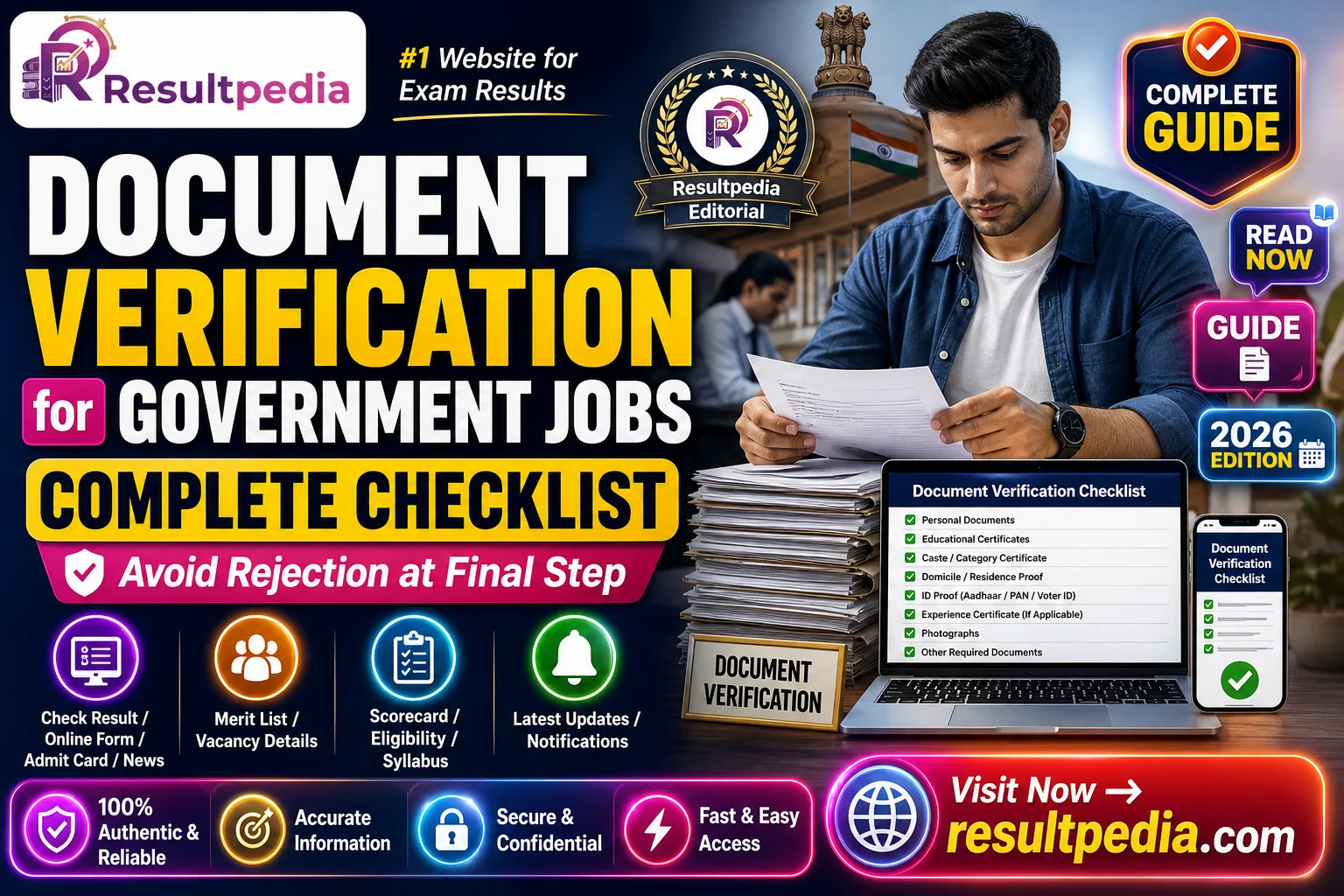
Document verification is the final gate before appointment, where officials check your originals against your application. This guide gives the complete checklist of documents to carry, how the DV process works, and the name/date and certificate-format mistakes that get genuine candidates rejected at the last step.
By Saurabh Kamal, Recruitment Process Editor. Published 15 June 2026. Last verified 15 June 2026 against central and state document-verification norms.
In short
- Document verification (DV) is the final gate: officials check your original certificates against your application form before you are appointed.
- Carry all originals plus 2–3 sets of self-attested photocopies — originals are checked and returned, copies are kept.
- The core set: education marksheets and certificates, photo ID, category and domicile certificates, and photographs.
- The most common rejections are name/DOB mismatches across documents and an OBC or EWS certificate in the wrong format or year — fix these before you go.
You have cleared the exam, the physical and the medical — and then a paperwork slip costs you the job. Document verification is where genuine candidates get tripped up, almost always over small, avoidable mistakes. This is the complete checklist of what to carry, how DV works, and the errors that get people rejected at the last step.
What is document verification?
Document verification (DV) is the stage where the recruiting authority checks your original documents against the details you entered in your application — your age, education, category and identity. The aim is to confirm you actually meet the eligibility you claimed. Officials compare each original with your photocopies and the form, tick it off a checklist, and in many cases verify your education certificates with the issuing board or university. It is the last hurdle before appointment, so getting it right matters as much as the exam.
The complete document checklist
Carry the originals and 2–3 self-attested photocopies of each:
| Category | Documents |
|---|---|
| Identity | Aadhaar, PAN, Voter ID / Passport / Driving Licence |
| Age proof | Class 10 (matriculation) certificate |
| Education | 10th, 12th, graduation/diploma marksheets and certificates (originals) |
| Category | SC/ST/OBC-NCL certificate (correct format) or EWS Income & Asset certificate |
| Domicile | Residence/domicile certificate (where required) |
| Photographs | Recent passport-size photos (several) |
| Special claims | Disability (PwBD) certificate, ex-servicemen discharge book, NOC for serving employees |
| Application | Printed online application, admit card, call letter |
Take more photocopies than you think you need — many DV centres keep one set per document.
How the DV process works
- You report at the scheduled time with your originals and photocopy sets.
- An official checks each original against your photocopy and your application form, ticking it off a checklist.
- Education certificates are matched, and may be verified with the board/university later.
- Identity, age, category and domicile are confirmed against the originals.
- Your originals are returned after the check; the self-attested copies are retained.
DV usually follows the written and physical stages — for instance after a physical-test result like the border-force trades shortlist, or an entrance rank card such as the Bihar polytechnic result.
The mistakes that get people rejected
Most DV rejections are not about missing eligibility — they are about inconsistent paperwork:
- Name or date-of-birth mismatch across documents — your name, father's name or DOB spelled or dated differently on the 10th certificate, Aadhaar and category certificate. Get them corrected before DV.
- OBC certificate not in central format — for central jobs, the OBC (non-creamy-layer) certificate must be in the Central Government format, not a state one, and current.
- EWS certificate of the wrong year — it must be valid for the current financial year; an old one is rejected. The rules are in the EWS or category certificate you'll need.
- Missing originals — bringing only photocopies. Originals are mandatory.
Fix name/DOB mismatches and certificate-format issues well in advance, because they cannot be sorted out on the spot. Browse openings by qualification once your documents are in order.
Document Verification: हिंदी सारांश
दस्तावेज़ सत्यापन (DV) चयन का अंतिम चरण है, जहां अधिकारी आपके मूल प्रमाण-पत्रों को आवेदन-फॉर्म से मिलाकर पात्रता की पुष्टि करते हैं। सभी मूल दस्तावेज़ तथा 2–3 सेट स्व-सत्यापित फोटोकॉपी साथ ले जाएं — मूल जांचकर लौटा दिए जाते हैं, कॉपी रख ली जाती हैं। आवश्यक दस्तावेज़: 10वीं/12वीं/स्नातक की मार्कशीट व प्रमाण-पत्र, फोटो पहचान (आधार/PAN/वोटर/पासपोर्ट), श्रेणी प्रमाण-पत्र (OBC केंद्रीय प्रारूप / EWS चालू वित्तीय वर्ष), निवास प्रमाण-पत्र, तथा फोटो। सबसे आम अस्वीकृति का कारण है — विभिन्न दस्तावेज़ों में नाम/जन्म-तिथि का अंतर, OBC प्रमाण-पत्र का गलत प्रारूप, या EWS प्रमाण-पत्र का पुराना वर्ष। इन्हें DV से पहले ही ठीक करा लें, क्योंकि मौके पर सुधार संभव नहीं होता।