
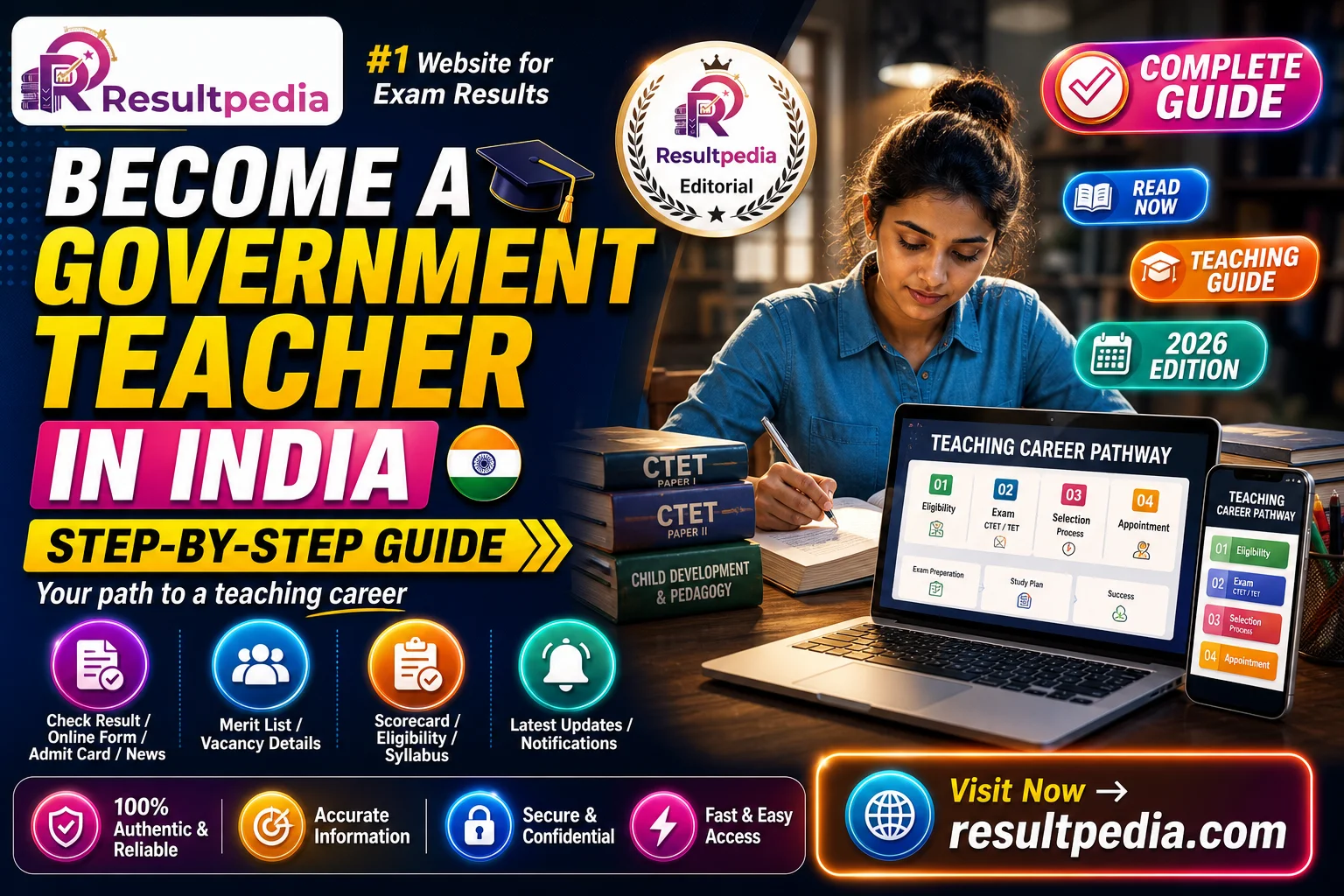
Becoming a government teacher depends on the level — PRT, TGT or PGT — each with its own qualification. You first get the teaching qualification (D.El.Ed or B.Ed), then clear the mandatory CTET/State TET eligibility test, then a recruitment exam like KVS, NVS or a state drive. College teaching needs a Master's plus UGC NET/SET instead.
By Saurabh Kamal, Teaching & Recruitment Editor. Published 15 June 2026. Last verified 15 June 2026 against CTET, KVS and state recruitment rules.
In short
- The route depends on the level: PRT (Classes 1–5), TGT (6–8/10) and PGT (11–12), each with its own qualification.
- You first need the teaching qualification (D.El.Ed or B.Ed), then you must clear an eligibility test — CTET or the State TET — which is mandatory but is not a job by itself.
- With the eligibility test cleared, you apply to a recruitment exam (KVS, NVS, or a state's TGT/PGT drive) and clear its written test and interview.
- For college teaching, the path is different: a Master's plus UGC NET/SET, not CTET.
"How do I become a government teacher?" has no single answer, because it depends on which class you want to teach. The qualifications, the eligibility test and the recruiting body all change between primary, upper-primary and senior-secondary levels. This guide lays out the full ladder so you can see exactly where you stand and what to do next.
The three teaching levels
| Level | Teaches | Qualification | Eligibility test |
|---|---|---|---|
| PRT (Primary) | Classes 1–5 | 12th + D.El.Ed / JBT (or B.El.Ed) | TET/CTET Paper 1 |
| TGT (Trained Graduate) | Classes 6–8 (up to 10) | Graduation 50% + B.Ed | TET/CTET Paper 2 |
| PGT (Post Graduate) | Classes 11–12 | Master's 50% + B.Ed | CTET (extended under NEP 2020) |
The percentage marks and exact diploma names vary a little by state and category, so confirm them in the recruiter's notice. The principle, though, is consistent: higher the class, higher the qualification.
Step 1 — get the teaching qualification
Before anything else, you need the training:
- For primary (PRT): after Class 12, do a D.El.Ed / JBT (a two-year diploma) or a four-year B.El.Ed.
- For TGT and PGT: after your degree (and Master's for PGT), do a B.Ed.
Without this professional qualification you cannot sit the eligibility test or be appointed, so it is the foundation step.
Step 2 — clear the eligibility test (CTET or State TET)
This is the gate everyone must pass. The Teacher Eligibility Test is the minimum qualification to be eligible for a government teaching post. CTET (Central TET) is for central-government schools and is accepted by many states; each state also runs its own State TET. You sit Paper 1 for primary and Paper 2 for upper-primary, and under NEP 2020 the CTET has been extended to cover PGT (Classes 9–12) as well. The difference between the two CTET papers is explained in the difference between the two CTET papers. Remember: clearing TET makes you eligible — it is not an appointment by itself.
Step 3 — clear a recruitment exam
With your qualification and a valid TET certificate, you apply to an actual recruitment:
- Central schools — KVS (Kendriya Vidyalaya) and NVS (Navodaya) recruit PRT/TGT/PGT through their own exams plus an interview. You can see a recent cycle on the central-school teaching results page.
- State schools — each state runs TGT/PGT and primary-teacher recruitments (often a single large drive) for its government schools.
These recruitment exams test subject knowledge and pedagogy, and selection is by merit (and interview where applicable).
Want to teach in a college instead?
College teaching is a separate track. To become an Assistant Professor, you need a Master's degree and a pass in UGC NET or a State SET — not CTET. The difference between the JRF and Assistant-Professor outcomes of that exam is covered in the college-lecturer eligibility test. Browse current openings on the teaching jobs hub.
Government Teacher: हिंदी सारांश
सरकारी शिक्षक बनने का रास्ता इस बात पर निर्भर करता है कि आप किस स्तर पर पढ़ाना चाहते हैं — PRT (कक्षा 1–5): 12वीं + D.El.Ed/JBT; TGT (कक्षा 6–8): स्नातक 50% + B.Ed; PGT (कक्षा 11–12): स्नातकोत्तर 50% + B.Ed। पहले शिक्षण योग्यता (D.El.Ed/B.Ed) प्राप्त करें, फिर अनिवार्य पात्रता परीक्षा CTET या राज्य TET उत्तीर्ण करें (यह केवल पात्रता है, नियुक्ति नहीं) — प्राथमिक के लिए Paper 1, उच्च-प्राथमिक के लिए Paper 2, तथा NEP 2020 के तहत अब CTET PGT तक विस्तृत है। इसके बाद KVS/NVS या राज्य की TGT/PGT भर्ती परीक्षा व साक्षात्कार पास करें। कॉलेज में पढ़ाने हेतु अलग रास्ता है — स्नातकोत्तर + UGC NET/SET।