
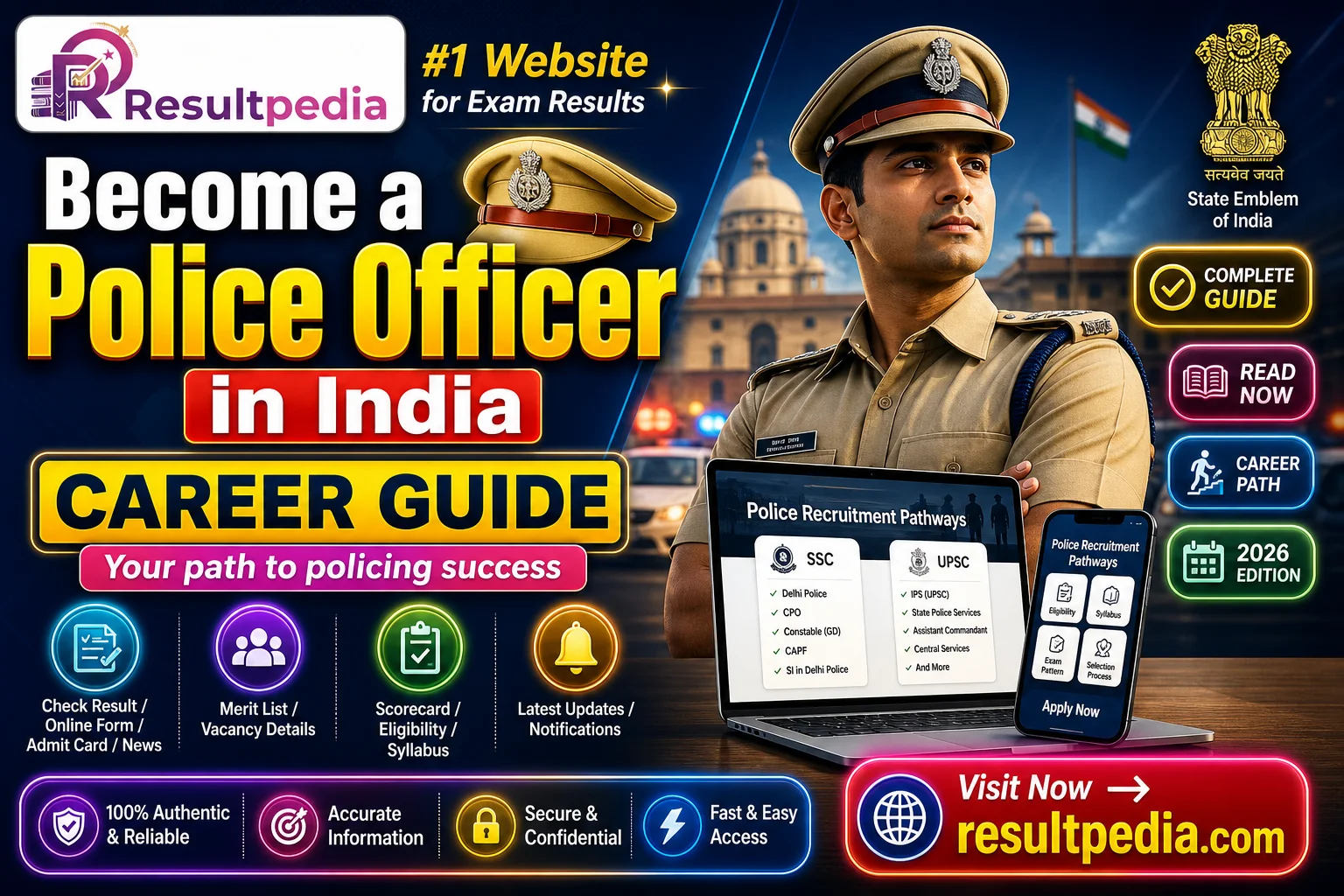
A police career has three entry points: constable after Class 12, sub-inspector after graduation, and IPS officer through the UPSC Civil Services Exam. This guide maps the eligibility, exams and physical standards for each route, and how you can rise through the ranks by promotion or a State PCS.
By Vishal Thakur, Police & State Recruitment Editor. Published 15 June 2026. Last verified 15 June 2026 against state police and SSC/UPSC recruitment rules.
In short
- There are three entry levels: Constable (after Class 12), Sub-Inspector (SI) (after graduation), and IPS officer (through the UPSC Civil Services Exam).
- Constable and SI are recruited by state police boards (and SSC CPO for SI in Delhi Police/CAPF); the IPS is recruited only through UPSC.
- Every route has a written test, a physical test (height, chest, running) and a medical and background check.
- You can also rise internally — a constable or SI can be promoted up the ranks over a career.
A police career has more than one door. You can start as a constable straight after Class 12, enter as a sub-inspector after a degree, or aim for the officer cadre through the civil-services exam. This guide maps all three routes — the eligibility, the physical standards and the exams — so you can pick the one that fits where you are now.
The three ways to join
| Entry | Minimum education | Recruited by | Becomes |
|---|---|---|---|
| Constable | Class 12 (some 10th) | State police board | Constable → Head Constable → ASI |
| Sub-Inspector (SI) | Graduation | State SI exam / SSC CPO | SI → Inspector → DSP (by promotion) |
| IPS officer | Graduation | UPSC Civil Services | ASP → SP → DIG → IG and above |
The same uniform, three very different starting points. Which one you target depends mainly on your current qualification and how high you want to start.
Route 1 — Constable (after Class 12)
The most accessible entry. State police forces recruit constables through a written test plus a physical efficiency/standard test (PET/PST) — height, chest and a timed run — and a medical check. The central armed forces fill constable (GD) posts through the SSC GD exam; the physical standards for that are laid out in the physical standards for the central constable exam. From constable you can be promoted over the years to Head Constable and Assistant Sub-Inspector.
Route 2 — Sub-Inspector (after graduation)
If you are a graduate, you can enter one rung higher as a Sub-Inspector. SI is recruited two ways:
- State SI exam — each state police board runs its own SI recruitment (written test + physical + medical). A recent example is the state sub-inspector result.
- SSC CPO — the Staff Selection Commission recruits SIs for Delhi Police and the central armed police forces (CAPFs) through the CPO exam.
From SI you can be promoted to Inspector and, in time, to Deputy Superintendent of Police (DSP).
Route 3 — IPS officer (the top route)
The Indian Police Service (IPS) is the officer cadre, and it has a single door: the UPSC Civil Services Examination, the same exam that recruits the IAS. Clearing it and getting allotted to the IPS makes you an Assistant Superintendent of Police, rising to SP, DIG, IG and above. How the IPS compares with the IAS and IFS is covered in the IPS route runs through the civil-services exam. You can also reach the officer ranks without UPSC — by clearing a State PCS, which recruits Deputy Superintendents of Police (DSP) directly.
Physical standards — the common gate
Whatever the route, you must clear a physical standard test: a minimum height and chest (typically around 165–170 cm for men and 150–157 cm for women, varying by state and post) and a timed run, plus a medical examination. There are relaxations for ST candidates and hill communities. Because the exact numbers differ by state and post, always read your recruitment's notification, and start your running and fitness practice early — many candidates clear the written stage but stumble at the physical. Browse live openings on the police and defence jobs hub.
Police Officer: हिंदी सारांश
पुलिस में भर्ती के तीन मुख्य रास्ते हैं — कांस्टेबल (12वीं के बाद, राज्य पुलिस भर्ती), सब-इंस्पेक्टर/SI (स्नातक के बाद; राज्य SI परीक्षा या SSC CPO), तथा IPS अधिकारी (UPSC सिविल सेवा परीक्षा द्वारा)। हर रास्ते में लिखित परीक्षा, शारीरिक परीक्षण (ऊंचाई, सीना, दौड़) तथा चिकित्सा व पृष्ठभूमि जांच होती है। कांस्टेबल व SI की भर्ती राज्य पुलिस बोर्ड (तथा दिल्ली पुलिस/CAPF हेतु SI के लिए SSC CPO) करते हैं, जबकि IPS केवल UPSC से होता है। State PCS के माध्यम से सीधे DSP भी बना जा सकता है। ऊंचाई/सीना/दौड़ के मानक राज्य व पद अनुसार भिन्न होते हैं (ST व पहाड़ी वर्गों को छूट), इसलिए अधिसूचना अवश्य देखें।