
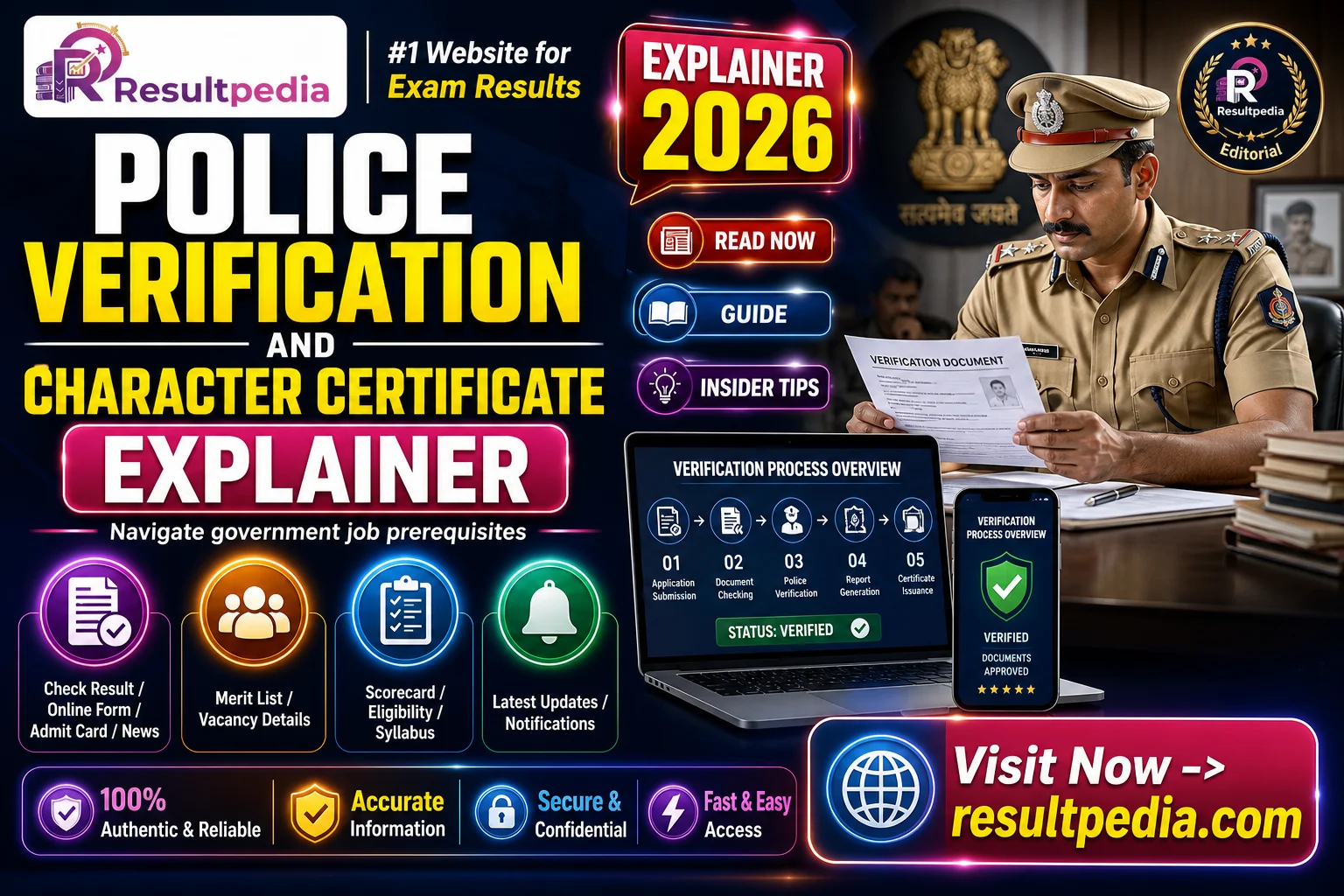
Most government jobs include a police (antecedent) verification and a character certificate before you join. Police verification checks your identity, address and criminal record, usually near appointment, through your local police station. A character certificate certifies good conduct and is issued by a gazetted officer or the head of your last institution. The rule that matters most is honesty on the attestation form: hiding a past case or pending FIR is treated far more seriously than the matter itself and can cancel candidature. How a pending case affects you depends on its nature, the post and the recruiting body's rules, so disclose fully and check the official instructions. This guide explains the process and how to avoid delays.
By Muskaan Chauhan, Senior Editor — Strategy & Prep. Published 8 July 2026. Last verified 8 July 2026.
In short
- Police (antecedent) verification checks your identity, address and criminal record — usually at the appointment stage, to confirm you are fit for government service.
- A character certificate is a standard document certifying your good conduct, typically issued by a gazetted officer or the head of your last institution.
- The attestation form is a declaration of honesty: hiding a past case or pending FIR is usually treated far more seriously than the case itself — always disclose truthfully.
- How a pending case or past record affects your candidature depends entirely on the recruiting body's rules and the nature of the case — do not rely on rumours; check the official attestation form and instructions.
For most government jobs, clearing the exam and document verification is not quite the finish line — there is often a police verification and a character certificate requirement before you actually join. These steps make many candidates anxious, especially if they have ever been near a legal matter. This guide explains what each involves, how to prepare, and the one rule that matters most: honesty on the attestation form.
What is police (antecedent) verification?
Police verification, also called antecedent verification, is a background check the recruiting body runs — usually near the appointment stage — to confirm that you are who you say you are and that there is nothing in your record that disqualifies you from government service. It typically checks:
- Your identity and permanent/current address.
- Whether you have any criminal antecedents — cases, convictions or pending proceedings.
The process usually works through the local police station of your address, who verify your details and report back to the recruiting authority. It can take a few weeks, which is why address accuracy on your form matters.
The character certificate
A character certificate is a formal document certifying that you are of good moral character and conduct. Recruiters usually accept one issued by:
- A gazetted officer,
- The head of the institution you last studied at, or
- Another authority named in the recruitment instructions.
Some recruitments provide a prescribed format for the certificate — use that format if given, and make sure the issuing authority's designation, seal and date are complete. Keep a couple of copies ready, as more than one stage may ask for it.
The attestation form — honesty is the rule that matters
Most government appointments include an attestation form where you declare your personal details and answer questions such as whether you have ever been arrested, prosecuted, convicted or have a case pending against you. This is the single most important document to handle correctly:
- Answer truthfully. If you have ever been involved in a legal matter — even one that was closed or in which you were acquitted — declare it exactly as the form asks.
- Non-disclosure is the real risk. Recruiting bodies and courts have repeatedly treated suppression of information on the attestation form as more serious than the underlying matter — it can lead to cancellation of candidature even where the case itself might not have.
- Attach documents for any declared matter (court order, acquittal, closure report) so the authority can assess it on facts.
In short: a declared, explained matter is assessed on its merits; an undeclared one, if discovered, is treated as dishonesty.
How a pending case or past record affects candidature
This is the question candidates worry about most, and the honest answer is: it depends — on the nature and stage of the case, the post, and the recruiting body's own rules. Minor, closed or acquitted matters are often viewed differently from serious or ongoing ones, and different services (especially uniformed and sensitive posts) apply stricter standards. Because the outcome turns on specifics and on rules that vary by recruiter, this guide cannot give a blanket answer, and you should not rely on forum rumours. Read the official attestation form and recruitment instructions, disclose fully, and if your situation is complex, consider proper legal advice. What is consistent across recruiters is the expectation of full, honest disclosure.
How to avoid delays in verification
- Give a correct, consistent address. Verification runs through your address's police station, so a wrong or outdated permanent vs current address is the most common cause of delay. Keep the address the same across your documents.
- Keep your character certificate ready in the prescribed format, with a valid issuing authority.
- Be reachable. The verifying officer may need to confirm details, so ensure your contact number and address on the form are current.
- Declare and document any legal matter up front, with supporting papers, rather than leaving it to surface later.
- Keep copies of everything you submit.
The takeaway
Police verification and the character certificate are routine final checks, not obstacles designed to fail you. The candidates who run into trouble are almost never those with a minor, honestly-declared matter — they are those who gave a wrong address, or who hid something that later came to light. Treat the attestation form as a test of honesty, keep your documents and address in order, and this stage becomes a formality on the way to joining. For the paperwork that precedes it, see our document verification checklist and the guide to common online-form mistakes.