
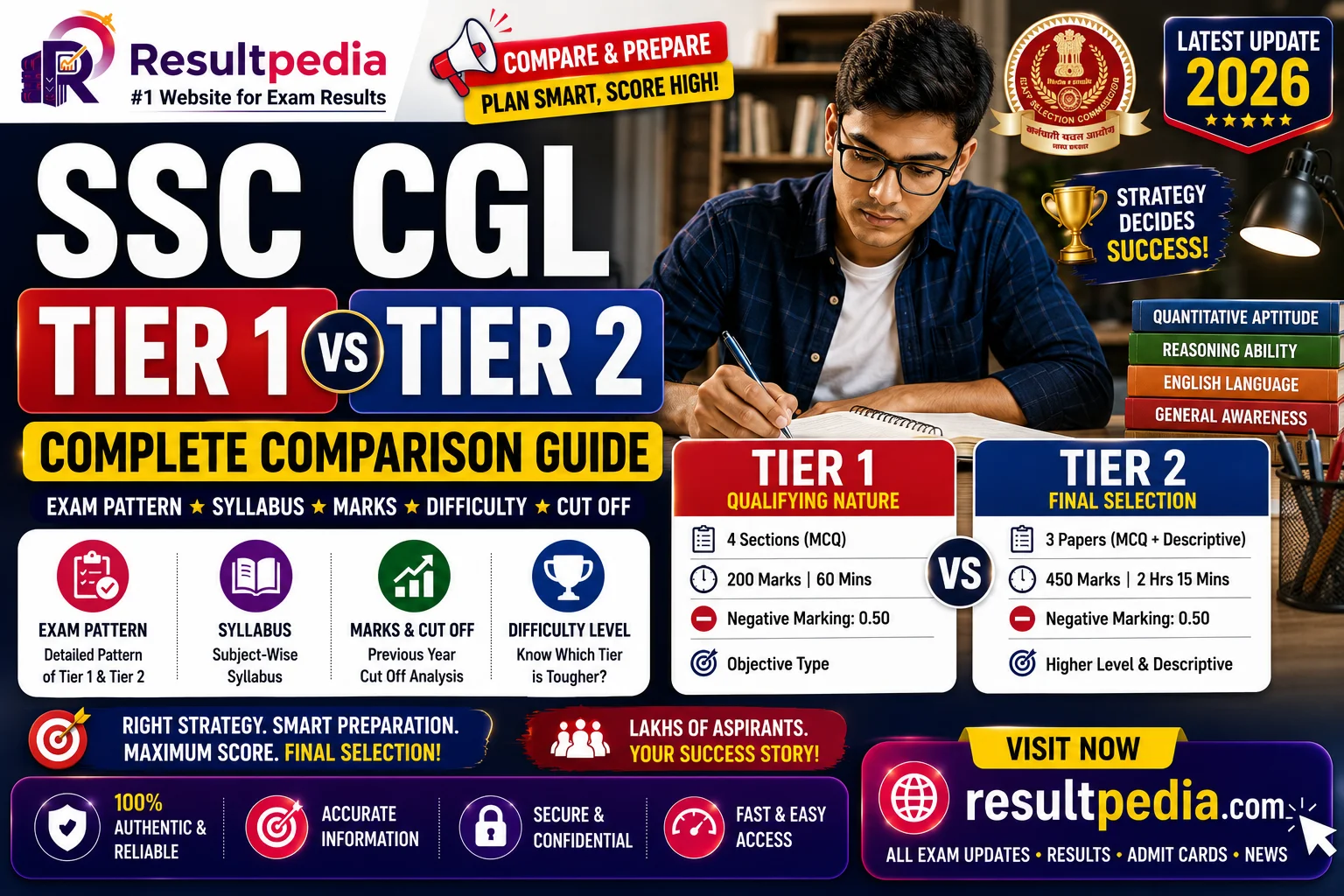
SSC CGL has two tiers: Tier-1 is the screening round (100 questions, 200 marks, four equal sections), and Tier-2 decides your post and final rank with a compulsory Paper 1 plus extra papers for statistical and accounts roles. This guide breaks down the pattern, syllabus depth, and cutoff logic of each.
By Vishal Thakur, Senior Editor — Central Recruitment desk. Published 22 May 2026. Last verified 22 May 2026 against the SSC CGL exam pattern.
TL;DR
- Tier-1 is the screening round — 100 questions, 200 marks, 60 minutes, four equal sections, with 0.50 negative marking.
- Tier-2 decides your post and final rank — its Paper 1 is compulsory for all posts, with extra papers for statistical (Paper 2) and accounts/audit (Paper 3) roles.
- Tier-2 carries heavier maths and English plus a computer module and a Data Entry Speed Test, and its negative marking is 1.0 per wrong answer.
- Cutoffs vary by post and category each year — AAO and Inspector posts have the highest cutoffs.
- Practical takeaway: clear Tier-1 comfortably, but win on Tier-2 — that is where merit is built.
Understanding how SSC CGL's two tiers differ is the difference between preparing efficiently and wasting effort. Tier-1 gets you through the door; Tier-2 decides which post you land. This guide breaks down the pattern, syllabus, and cutoff logic of each. For the full cycle, see the SSC CGL 2026 notification and the SSC Jobs hub; to plan your study, read our SSC CGL preparation plan.
Tier-1 — the screening round
Tier-1 is a single computer-based test of 100 questions for 200 marks in 60 minutes, split into four equal sections — General Intelligence & Reasoning, General Awareness, Quantitative Aptitude, and English Comprehension — at 25 questions of 2 marks each. There is a 0.50 negative marking per wrong answer and a 15-minute limit per section. Tier-1 is largely a qualifying-and-screening stage in the current pattern: you must clear the category cutoff to advance, and your weakest section, not your strongest, decides whether you make it. Treat it as a hurdle to clear comfortably rather than the place to maximise marks.
Tier-2 — where your post and rank are decided
Tier-2 is the decisive stage. Paper 1 is compulsory for all posts and runs three sections across two sessions: Session 1 has Module 1 (Mathematical Abilities, 30 Q) and Module 2 (Reasoning & General Intelligence, 30 Q); Session 2 has Module 1 (English, 45 Q) and Module 2 (General Awareness, 25 Q) plus a Computer Knowledge module (20 Q) and a Data Entry Speed Test (DEST). The MCQ modules carry 1.0 negative marking. Paper 2 is for Junior Statistical Officer / statistical posts, and Paper 3 is for Assistant Audit/Accounts Officer and accounts roles — you sit these only if you applied for those posts. Because the final merit list is built from Tier-2 scores, this is where serious candidates focus their depth.
Syllabus — what changes between the tiers
The subjects overlap, but Tier-2 goes deeper. Tier-1 maths is arithmetic-heavy with some advanced topics; Tier-2 maths expands into more demanding algebra, geometry, trigonometry, and data interpretation. Tier-1 English tests basic comprehension and grammar; Tier-2 English is longer (45 questions) with harder vocabulary and error-detection. Tier-2 adds a computer knowledge module and the typing/DEST element that Tier-1 does not have. So a candidate who only drilled Tier-1-level material will find Tier-2 a step up — plan the depth from the start.
Cutoff logic — how the post is allotted
There is no single SSC CGL cutoff. Cutoffs are published post-wise and category-wise, and they vary every year with difficulty and vacancies. The highest cutoffs are for the most-preferred posts — Assistant Audit Officer (Pay Level 8) and the Inspector posts — while clerical posts have lower cutoffs. You qualify Tier-1 against a screening cutoff, then your Tier-2 score determines which post in your preference list you actually get. The strategic implication: list your post preferences honestly and aim your Tier-2 score at the cutoff band of the post you want. For the pay attached to each post, see our SSC CGL salary guide.
SSC CGL Tier-1 vs Tier-2: हिंदी सारांश
SSC CGL दो टियर में होता है। Tier-1 स्क्रीनिंग राउंड है — 100 प्रश्न, 200 अंक, 60 मिनट, चार बराबर सेक्शन, 0.50 नेगेटिव मार्किंग। Tier-2 आपकी पोस्ट और फाइनल रैंक तय करता है — इसका Paper 1 सभी पदों के लिए अनिवार्य है, और सांख्यिकी (Paper 2) व अकाउंट्स/ऑडिट (Paper 3) के लिए अतिरिक्त पेपर होते हैं। Tier-2 में गणित और अंग्रेज़ी कठिन हैं, कंप्यूटर मॉड्यूल व DEST भी है, और नेगेटिव मार्किंग 1.0 है। कट-ऑफ हर साल पोस्ट व श्रेणी के अनुसार बदलती है — AAO व Inspector की सबसे ऊँची। रणनीति: Tier-1 आराम से पास करें, पर मेरिट Tier-2 में बनती है। तैयारी के लिए SSC CGL preparation plan पढ़ें।