
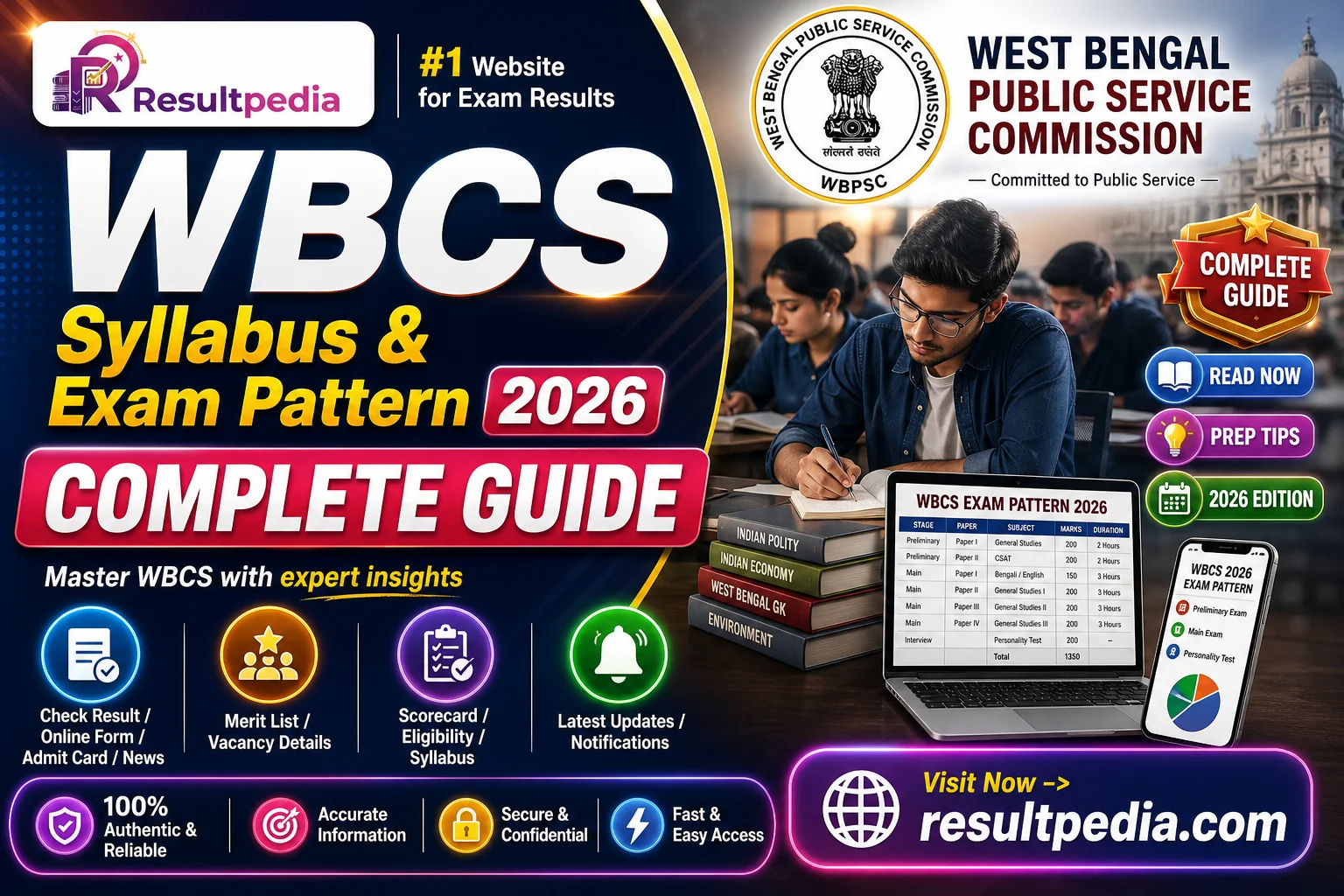
WBCS has three stages — a screening Preliminary (200-mark objective paper), a Mains of eight papers (six compulsory + two optional, optional only for Group A/B), and a Personality Test. The prelims is qualifying only; the final merit comes from Mains + Personality Test. This guide breaks down the full prelims and mains pattern, the compulsory and optional papers, group-wise totals, and how to prepare.
By Saurabh Kamal, Recruitment Policy Editor. Published 16 June 2026. Last verified 16 June 2026 against the WBPSC WBCS pattern.
In short
- WBCS has three stages: a screening Preliminary (200-mark objective paper), a Mains (eight papers), and a Personality Test.
- The prelims is qualifying only — its marks don't count towards the final merit; they decide who sits the Mains.
- The Mains has 6 compulsory + 2 optional papers (optional only for Group A & B), each of 200 marks; totals are 1800 (A/B), 1350 (C) and 1300 (D).
- The final merit is built from the Mains + Personality Test, conducted by the West Bengal Public Service Commission (WBPSC).
The West Bengal Civil Service (WBCS) is the state's top administrative exam, run by the West Bengal Public Service Commission (WBPSC). Knowing the exact pattern — how many papers, what each carries, and what changes between groups — is the first real step in preparing for it. This guide lays out the prelims and mains pattern, the compulsory and optional papers, and how the final merit is decided.
WBCS exam pattern 2026 — the three stages
| Stage | Type | Counts towards merit? |
|---|---|---|
| Preliminary | 1 objective paper (200 marks) | No — screening only |
| Mains | 8 papers (objective + descriptive) | Yes |
| Personality Test | Interview | Yes |
WBCS Preliminary syllabus & pattern
The preliminary is a single objective paper of 200 questions for 200 marks, to be done in 2 hours 30 minutes, with roughly one-third negative marking for a wrong answer. It is purely a screening test. The paper covers eight subjects:
- English Composition
- General Science
- Current Events of National & International Importance
- History of India
- Geography of India (with special reference to West Bengal)
- Indian Polity & Economy
- Indian National Movement
- General Mental Ability (Reasoning)
Because it only decides who qualifies for the Mains, the smart approach is a balanced attempt across these eight areas rather than over-investing in any one. If your prelims is already done, you can estimate your score and check the cut-off on our WBCS prelims answer key page.
WBCS Mains syllabus & pattern
The Mains is where selection is really decided. It has eight papers — six compulsory and two optional — each carrying 200 marks and lasting 3 hours, in a mix of objective and descriptive formats for the 2026 cycle.
| Group | Papers | Total marks |
|---|---|---|
| Group A & B | 6 compulsory + 2 optional | 1800 |
| Group C | 6 compulsory | 1350 |
| Group D | 6 compulsory | 1300 |
The two optional papers (VII & VIII) are mandatory only for candidates targeting Group A and Group B services; Group C and D candidates write only the compulsory papers.
The six compulsory papers
- Paper I — Bengali / Hindi / Urdu / Nepali / Santali (letter, précis, composition, translation)
- Paper II — English (letter, précis, composition, translation)
- Paper III — General Studies I (Indian history, geography of India with West Bengal focus)
- Paper IV — General Studies II (science, environment, polity, economy, current events)
- Paper V — The Constitution of India & the Indian Economy (including the role of the planning/economic bodies)
- Paper VI — Arithmetic & Test of Reasoning
Optional subjects (Group A & B)
You choose one optional subject, written as two papers. The list is wide and includes Bengali, Hindi, Sanskrit, English, Pali, Arabic, Persian, French, Urdu, Santali, Comparative Literature, Agriculture, Animal Husbandry & Veterinary Science, Anthropology, Botany, Chemistry, Civil Engineering, Commerce & Accountancy, Computer Science, Economics, Electrical Engineering, Geography, Geology, History, Law, Management, Mathematics, Mechanical Engineering, Medical Science, Philosophy, Physiology, Physics, Political Science, Psychology, Sociology, Statistics and Zoology. Pick the optional you are strongest in — it carries 400 of the 1800 Group A/B marks.
Personality Test & final merit
Candidates who clear the Mains are called for the Personality Test (interview), which assesses general awareness, personality traits and suitability for service. The final merit list is prepared from the Mains and Personality Test together — the prelims score plays no part in it. WBPSC then allots Group A, B, C or D posts strictly by merit and preference.
How to prepare for WBCS 2026
Start from the pattern, not random study. Build a strong base in NCERT-level history, geography and polity for both the prelims and General Studies papers; track West Bengal–specific geography and current affairs, which is where WBCS differs most from other state exams; and lock your optional subject early if you are aiming for Group A/B. Because the prelims is only a gateway, do not over-prepare for it at the cost of the Mains, where the real competition lies. For aspirants comparing this route with the national civil service, the way the UPSC civil service exam has evolved is a useful reference, and you can browse more state openings on the West Bengal hub.
WBCS Syllabus 2026: हिंदी सारांश
पश्चिम बंगाल सिविल सर्विस (WBCS) परीक्षा तीन चरणों में होती है — प्रीलिमिनरी (1 वस्तुनिष्ठ पेपर, 200 अंक, 2.5 घंटे, 8 विषय, लगभग 1/3 नेगेटिव मार्किंग; केवल स्क्रीनिंग), मेन्स (8 पेपर) तथा पर्सनैलिटी टेस्ट। मेन्स में 6 अनिवार्य + 2 वैकल्पिक पेपर होते हैं (वैकल्पिक केवल ग्रुप A व B के लिए), प्रत्येक 200 अंक व 3 घंटे; कुल अंक — ग्रुप A/B 1800, ग्रुप C 1350, ग्रुप D 1300। प्रीलिम्स के अंक अंतिम मेरिट में नहीं जुड़ते; अंतिम चयन मेन्स व पर्सनैलिटी टेस्ट के आधार पर WBPSC द्वारा होता है। तैयारी पैटर्न से शुरू करें — इतिहास, भूगोल व राजव्यवस्था की मजबूत नींव बनाएं, पश्चिम बंगाल-केंद्रित करेंट अफेयर्स पर ध्यान दें, और ग्रुप A/B के लिए वैकल्पिक विषय जल्दी तय करें।