
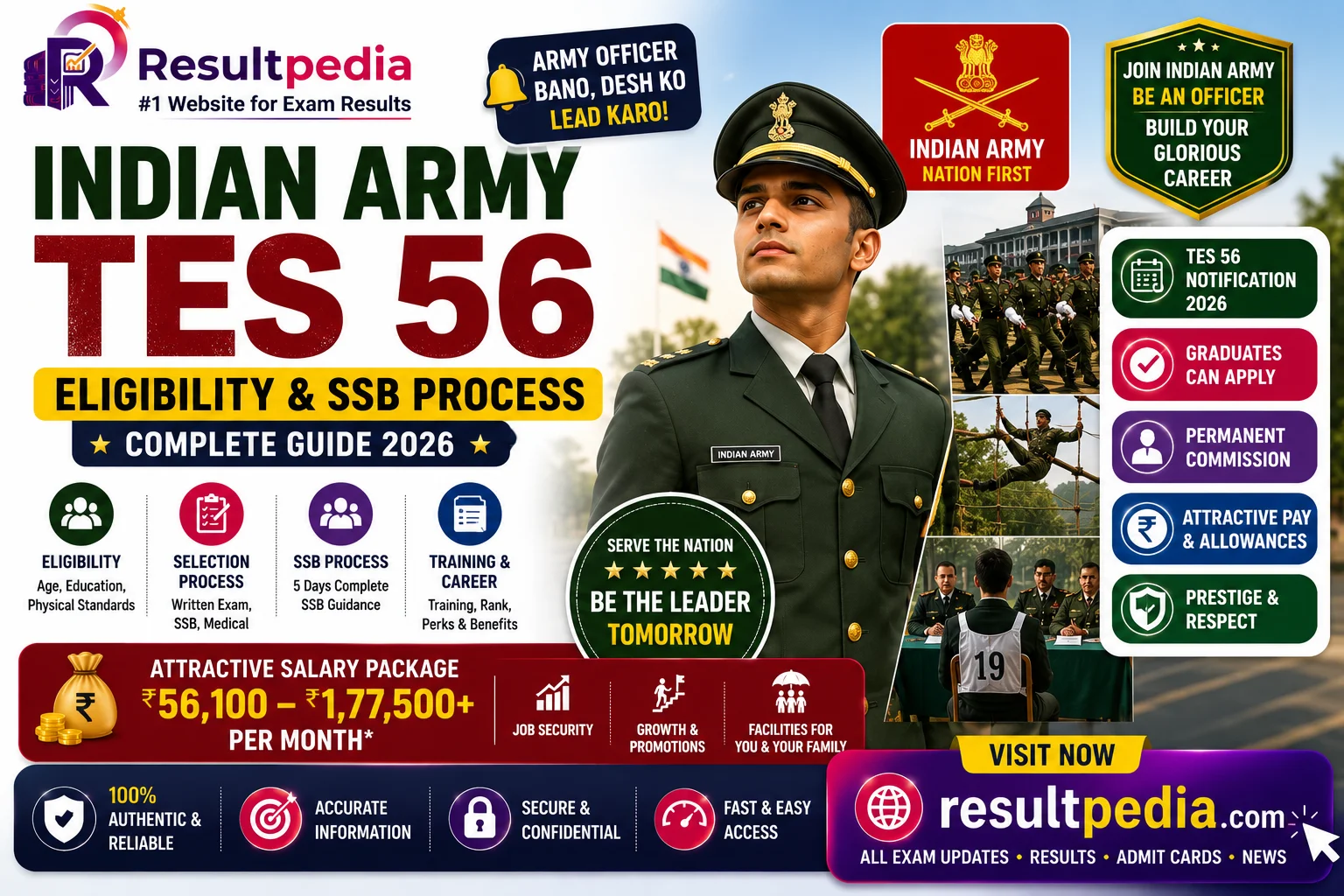
The Technical Entry Scheme (TES 56) lets science students become Army officers right after Class 12, with no separate written exam. Shortlisting is on the JEE Main score, then the SSB interview and medical decide selection. This guide covers eligibility, the selection path, training, and how to prepare for the SSB.
By Pawan, Senior Editor — Defence & Railway desk. Published 22 May 2026. Last verified 22 May 2026 against the Indian Army TES 56 notification.
TL;DR
- TES 56 is the Army's 10+2 Technical Entry Scheme — a route to a Permanent Commission as a Lieutenant with an engineering degree, straight after Class 12.
- Eligibility: unmarried male, PCM with ≥60%, a valid JEE Main 2026 score, age 16.5–19.5.
- There is no written exam — shortlisting is on your JEE Main score, then the SSB interview and medical decide selection.
- You get a B.E./B.Tech degree plus military training over ~4–5 years and are commissioned as a Lieutenant.
- For ~90 provisional vacancies, the SSB is the real filter — prepare for it seriously.
The Technical Entry Scheme (TES 56) is one of the best routes for a science student to become an Army officer right after 12th — and uniquely, it does not require clearing a separate written exam. If you have PCM and a JEE Main score, you are most of the way to being eligible. This guide explains the eligibility, the selection path, and how to approach the SSB. For the application, see the Indian Army TES 56 2026 page and the Defence Jobs hub.
Who is eligible for TES 56
TES 56 is open to unmarried male candidates who have passed Class 12 in the science stream with Physics, Chemistry, and Mathematics, scoring at least 60% aggregate in these subjects, and who have a valid JEE Main 2026 score. The age window is 16.5 to 19.5 years (born between 2 July 2007 and 1 July 2010 for this cycle). There is no application fee. Because the JEE Main score is mandatory, this scheme is best suited to science students who were already preparing for engineering entrances — your JEE effort doubles as your Army shortlisting basis.
Selection — no written exam, the SSB decides
This is what makes TES distinctive: there is no Army-conducted written test. The selection runs in three steps:
- Shortlisting on JEE Main score — the Army sets a cut-off based on JEE Main performance and the number of applicants.
- SSB interview — shortlisted candidates are called to a Services Selection Board for a five-day assessment of officer-like qualities.
- Medical examination — clearing the SSB leads to a medical, after which the final merit list is drawn.
So your JEE Main score gets you the call, but the SSB is the real filter — the majority of shortlisted candidates are not recommended, so it deserves dedicated preparation rather than being treated as a formality.
Training and commissioning
Selected cadets undergo about four to five years of training — beginning with basic military training and continuing through technical engineering instruction at the Army's technical institutions. On completion, you earn a B.E./B.Tech degree along with your military training and are commissioned as a Lieutenant with a Permanent Commission. A permanent commission means a full-length officer career, unlike the short-service routes — one of the biggest attractions of TES over some other entries.
How to prepare for the TES SSB
Since there is no written exam to clear, channel your effort into two things. First, maximise your JEE Main score — a higher score improves your shortlisting odds. Second, prepare for the SSB from early: work on the psychological tests (TAT, WAT, SRT), group tasks, and the personal interview, and build genuine officer-like qualities — communication, decision-making, and physical fitness. Mock SSB practice and honest self-assessment help far more than rote learning. For other after-12th officer routes, compare AFCAT vs NDA vs CDS; for broader options, see best government jobs after 12th.
Indian Army TES 56: हिंदी सारांश
TES 56 भारतीय सेना की 10+2 टेक्निकल एंट्री स्कीम है — 12वीं के तुरंत बाद इंजीनियरिंग डिग्री के साथ स्थायी कमीशन (लेफ्टिनेंट) पाने का रास्ता। पात्रता: अविवाहित पुरुष, PCM में ≥60%, वैध JEE Main 2026 स्कोर, उम्र 16.5–19.5 वर्ष। कोई लिखित परीक्षा नहीं — शॉर्टलिस्टिंग JEE Main स्कोर पर, फिर SSB इंटरव्यू और मेडिकल चयन तय करते हैं। लगभग 4–5 वर्ष की ट्रेनिंग के बाद B.E./B.Tech डिग्री और लेफ्टिनेंट का स्थायी कमीशन मिलता है। चूँकि लिखित परीक्षा नहीं है, असली फिल्टर SSB है — इसकी गंभीर तैयारी करें। आवेदन के लिए Indian Army TES 56 2026 पेज देखें।